


About the Youth Wellness Champions Program
Index
Introducing the Youth Wellness Champions Program
Sometimes we all need a little help from friends. This is especially true for youth in terms of their mental health and well-being. Good mental health is important for everyone, including youth.
Mental health, illness and substance use among youth is a very serious issue. The good news is that peer-support-based interventions such as the Registered Nurses’ Association of Ontario (RNAO) Youth Wellness Champions (YWC) program help find solutions.
Whether you’re an adult or a youth seeking to pave a brighter future for other young Canadians, our YWC Toolkit will help you be better informed, inspired and most important of all, involved in helping to create supportive, inclusive and resilient communities.
What is the Youth Wellness Champions Program?
The Youth Wellness Champions Program (YWC Program), funded by the Government of Ontario, is an innovative, peer-based program based on youth engagement principles, designed to help youth develop the knowledge and skills they need to cope with mental health and substance use issues.
When it comes to mental illness, youth is a critical period: most people living with a mental illness see their symptoms begin before age 18. There is also a well-established relationship between mental illness and substance use.
Background & key facts
Ontario youth are at risk. The mental health problems that adults experience – such as depression and anxiety – affect youth as well. Although it’s easy to discount the emotional struggles youth cope with as “typical teenager issues”, the journey into adulthood poses unique, complex pressures.
For the last three decades, the mental health needs of Ontario’s children and youth have been steadily increasing.
Evidence from the Canadian Mental Health Association paints a stark picture:
There is also a well-established relationship between youth, mental illness and substance use:
Children with mental illness tend to initiate substance use at earlier ages, and are more likely to develop problematic substance use than children without these disorders.
And of great concern: More than four out of 10 students report that, in the past year, there was a time they wanted to talk to someone about a mental health problem, but did not know where to turn.
The promise of early interventions
The good news is that early interventions for youth with mental health issues not only improve quality of life, but have potential benefits in terms of health-care system costs.
According to the Mental Health Commission of Canada, establishing the foundation for healthy emotional and social development, as well as prevention and early intervention, are key to ensuring the mental wellbeing of every Canadian. Without the right supports, people with mental illness and substance use problems, their caregivers and their families can experience great suffering.
How YWC works
Peer-to-peer programs like YWC are powerful tools that help shifts attitudes from a mental illness focus to a mental health promotion lens. Why? Peer leaders are easier to relate to than adults – they can more easily contextualize messages and expectations for a youth audience. They share important knowledge that can help both youth and adult allies with recognition, support, prevention, early intervention efforts, and (where appropriate) resilience.
The YWC Program is based on an understanding that peer leaders are easier to relate to than adults; they can more easily contextualize messages and expectations to address the needs of their peers. See the YWC Support Pillars section for information about youth engagement principles.
Our approach is multifaceted but straightforward. It uses a peer-led, multi-partner, multi-component youth engagement model, involving local public health units, district school boards and schools to mentor Youth Champions to plan, implement, and evaluate local youth engagement and health promotion activities within their schools and communities.
- Training adult allies
- Developing and training Youth Champions
- Planning and implementing local health promotion initiatives aimed at youth
- Celebrating achievements and evaluating progress
Our success hinges on adequate training of both youth and adults at the start of the program to learn about mental health promotion, stigma reduction, substance use prevention, youth facilitation and leadership techniques, and how to work with Youth Champions. Partner collaboration, networking and support and capacity building are all used to create a strong foundation.
Program Support Pillars
To best understand the relationship between mental health and mental illness, experts look to the “mental health continuum” model. It describes mental health and illness as more than the presence or absence of emotional states; nor are they at opposite ends of a continuum. In fact every person lies somewhere along the mental health continuum and this can fluctuate on a day-to-day basis.
That means individuals can experience complete mental health even if they have been diagnosed with a mental illness. Similarly, individuals who are free of a diagnosed mental illness can still experience poor mental health if they have poor coping mechanisms.
Bottom line: mental well-being is seen as “a balance of the mental, physical, spiritual, and emotional” that gives everyone—even the most vulnerable or mentally ill—an opportunity to live as a whole and healthy individual. The model explains that this balance is enhanced when people feel like their lives have a purpose, they have hope for their future, they feel a sense of belonging and connectedness, and they have a meaning and understanding of how their lives are part of creation and a rich history.
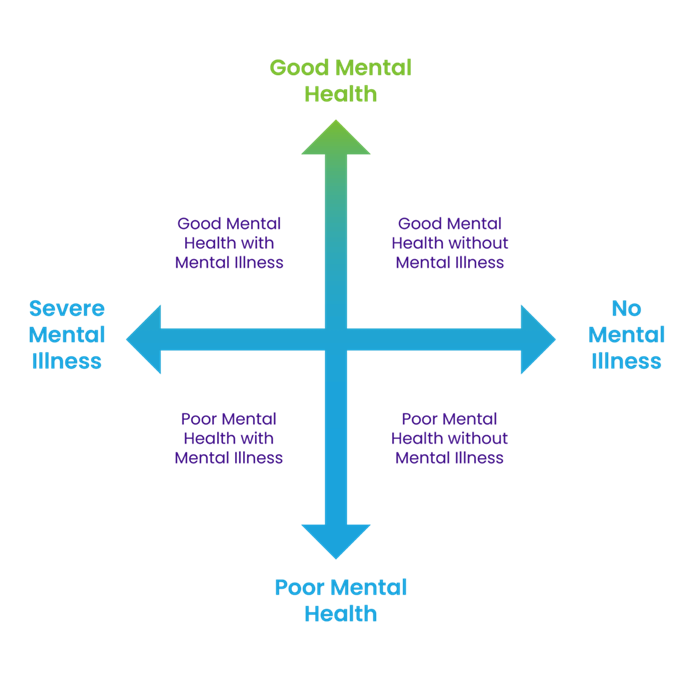
School Mental Health Ontario, The Dual Continuum of Mental Health, Understanding mental health - Students - School Mental Health Ontario
Youth engagement is the meaningful and sustained involvement of youth in an activity focused outside the self. It means empowering young persons as partners in their care (CYMHA Quality Standards for Youth Engagement). Youth Engagement models are central to the YWC Program, where youth and adults work together in improving youth mental health.
Youth engagement, as a framework for use in various practice settings, strives to involve youth as valued partners in addressing issues and making decisions that affect them or that they believe are important. Models generally recognize young people’s right to participate in decisions that impact them and acknowledge the great skills and strengths they bring to the table. Youth engagement occurs on a continuum, from youth as passive recipients of services to youth being engaged and seen as equal partners in their care.
Youth engaged in an authentic and meaningful way, leads to the development of the protective factors that promote positive youth development and prevent youth from engaging in risk-taking behaviours. Current research indicates that youth engagement (YE) Models offer a variety of positive outcomes for youth, including lower rates of substance use, lower levels of depression, a significant reduction in dropout rates in school, higher academic performance and lower rates of conflict with the law, particularly for youth who have been categorized as “high risk”.

Manipulation
Young people are directed by adults, without genuine opportunities to provide input.
Decoration
Young people are invited to the table, but given little to no purpose, influence or decision making power.
Tokenism
Young people are included for the sake of saying youth are included—especially those with diverse identities.
Informed
Young people are kept aware of programs, services or policy changes without contributing to the process.
Consulted
Young people have roles, provide input and are told how their input impacts adult decision making.
Co-development & partnership
Young people jointly develop all projects, services and processes that impact or interest them. They have the
opportunity to lead activities, share in decision making and work as equalpartners with adults. Young people and adults have authentic relationships (genuine, trusting, collaborative) in which youth expertise and experience are respected and valued.
Knowledge Institute on Child and Youth Mental Health and Addictions. (N.D.) Youth engagement traffic light [Infographic].
For more information see Enhancing Healthy Adolescent Development, an RNAO Best Practice Guideline® that identifies multiple strategies that directs nursing practice in enhancing healthy adolescent development.
The shift in working with youth as clients to engaging them as decision makers can at times seem overwhelming. In order to succeed, youth, adults and the organization as a whole must be open and willing to take risks, think outside the box and develop new attitudes towards youth—not as problems that need fixing, but rather resources to be tapped into.
Roger Hart’s “Ladder of Youth Participation” highlights eight different levels of youth participation and decision-making power. It is a useful tool that challenges us to reflect on the level of participation that is wanted, needed, and possible, as well as to identify barriers to meaningful participation and how they can be overcome. In Hart’s model, the top rung is achieved when adults and youth share decision making as partners and work together (in synergy).
The YWC Program encourages the creation of opportunities with high levels of participation and decision-making power so youth can make change, direct their own activities, and assume shared responsibility with appropriate levels of support. When working with young people, it is important to involve them as partners as early as possible in the decision-making process for an issue, activity or initiative.
Buy-In
The YWC Program aligns with all five of the foundations in the Foundations for a Healthy School approach as well as the Ontario Curriculum. It is youth-led and encourages students to be active participants and contributors to their learning and understanding of mental health promotion.
The YWC Program aligns with all five of the foundations in the Foundations for a Healthy School approach as well as the Ontario Curriculum. It is youth-led and encourages students to be active participants and contributors to their learning and understanding of mental health promotion. Students learn about mental health, mental illness, and substance use and are better equipped to support their peers.
We encourage open and respectful discussion of mental health topics fostering a positive and supportive environment and creating inclusion and belonging within the school community. Our focus on mental health promotion can easily be integrated to support healthy schools policies.
The Ontario Curriculum outlines the required knowledge and skills students need for success on the pathway they choose. Each grade and course builds on the material from the previous ones and progresses along with students’ developmental growth. The curriculum is developed by educators and is supported by research, experts, and key partners.
Alignment with the Ontario Curriculum
To enhance its utility, effectiveness, and relevance, the YWC Program is aligned with the Ontario curriculum’s skills and expectations that are outlined for each grade. This alignment will support integrating our program into daily learning for students regarding their mental health and wellbeing. The attached document depicts the alignment of the YWC Program to the Ontario curriculum by grade and skill needed to be developed. The table also itemizes primary audience and the rationale as to how YWC can support learnings.
PPM 169 was released in July 2023 by the health and education ministries. This memorandum outlines the requirements for school authorities and school boards to provide evidence-informed mental health promotion, prevention, and early intervention services to the student population in a culturally-safe manner. The memorandum also stresses the importance of school boards working with the provincial system of care to provide clear pathways for support to community and hospital mental health services for children and youth. A clear linkage of PPM 169 to the YWC Program is the emphasis on well-being and mental health of students as an integral component to their learning.
Schools represent an ideal place for mental health promotion, prevention, and early identification through school-based programs and interventions and by equipping students with knowledge and skills to be aware of and advocate for their mental health. The following table describes alignment of PPM 169 to the YWC Program.
The Ontario Public Health Standards are a set of guidelines and requirements that were developed by the ministry of health to ensure that public health units are providing consistent and quality public health services.
The YWC Program aligns with and meets several of the criteria outlined in the standards which may be helpful for Public Health Nurses and other public health professionals working within schools that are considering implementing the Youth Wellness Champions Program. For a complete list of how the YWC Program aligns with the Ontario Public Health Standards, please see the table included in the resource section.
Resources

View all Resources and Tools
