RNAO coaches can help

Through collaborations with LTC homes, our team of coaches work towards improving resident care and promoting positive workplaces by implementing RNAO’s clinical and healthy work environment best practice guidelines.

Contact a coach

Identify where you can improve

Use RNAO's gap (opportunity) analysis tool to help identify where evidence-based best practice recommendations can improve your organization's current practice.

Intra-professional collaboration

Promotes effective teamwork and communication within the interdisciplinary team members. Includes tools and strategies to enhance shared decision-making, mutual respect, and coordinated resident care. 

All resources

External link
The website gives an overview on the accreditation program for long-term care called Qmentum Global for Long-Term Care. Reference: Accreditation Canada (n.d.). Qmentum Global™ for Long-Term Care (accreditation.ca).    
External link
This website provides an overview of the Accreditation Canada program for long-term care called, Qmentum Global for Long-Term Care. Reference: Accreditation Canada (n.d.). Qmentum Global for Long-Term Care.  
External link
This article describes the results of a consultation facilitated during the June 2017 CNA annual meeting of members. It outlines some of the opportunities nurses have to provide input into future CNA initiatives on strengthening intra-professional collaboration. © Copyright 2025 Canadian Nurses Association
External link
CNA is the national professional voice of registered nurses in Canada. Representing nearly 139,000 registered nurses, CNA’s members include: Provincial and territorial nursing associations and colleges Independent RNs from Ontario and Quebec Retired nurses Canadian Nursing Students’ Association Canadian Network of Nursing Specialties © Copyright 2025 Canadian Nurses Association.
External link
There are nurse mentors throughout Canada who support and assist aspiring nurses through the Canadian Nurses Association (CNA) Certification Mentorship Program. Nurse mentors have current CNA certification and at least three years of experience in a nursing specialty. The toolkit offers guidance for the process. Revised December 2021
External link
This is a short and breezy introduction to coaching and the GROW model Reference: Heath, M. (2015) 
External link
This link takes you to the Canadian Nurses Association page that explains the Code of Ethics and the 7 values related to the nursing profession. © Copyright 2025 Canadian Nurses Association
External link
This document on a collaborative practice was created by three nursing regulatory bodies in Alberta.  The paper incorporates five principles that are believed to maximize client health-care outcomes and effective teamwork. The content is transferrable and relevant to nurses practicing in Ontario. 
External link
College of Nurses of Ontario- Code of Conduct for Nurses is a guide to support nurses with the professional practice standards by providing detailed guidance nurses require for safe and ethical care. The website includes information, the guiding document and related video.  © 2025 College of Nurses of Ontario  
External link
This College of Nurses of Ontario document defines scope of practice for nurses. July 2025  
External link
Findings from a quality improvement project which aimed to focused on understanding the problems related to information exchanges between nurses.  Christine Johnson, RN, MN, GNC(C), is a Clinical Nurse Specialist in the Rehab and Geriatric Program, Health Sciences Centre, Winnipeg. Tricia Carta, RN, MN, is a Clinical Nurse Specialist in the Burn Program, Health Sciences Centre. Karen Throndson, RN, MN, is a Clinical Nurse Specialist in the Cardiac Program, Health Sciences Centre.
External link
This tips and tools guide is designed to assist you to better understand and learn how to plan, provide, develop and sustain interprofessional health care in your work environment. Registered Nurses of Ontario ( 2013) Developing and Sustaining Interprofessional Health Care: Tips and Tools for Health-care Teams, Toronto. ON.  
External link
This tips and tools guide is designed to assist you to better understand and learn how to plan, provide, develop and sustain interprofessional health care in your work environment. The information contained in this guide is based on the RNAO Healthy Work Environment Best Practice Guideline: Developing and Sustaining Interprofessional Health Care: Optimizing Patient, Organizational and Systems Outcomes and includes an Interprofessional Competency Framework Self-Assessment Tool.  
External link
Les présentes lignes directrices sur les pratiques exemplaires, Développement et maintien des soins de santé interprofessionnels : optimisation des résultats pour le patient/client, l’organisme et le système sont conçues pour favoriser des milieux de travail sains. Les présentes lignes directrices déterminent les pratiques exemplaires pour faciliter, améliorer et maintenir le travail d’équipe ainsi que la collaboration interprofessionnelle, et pour accroître les résultats positifs pour les patients/clients, les systèmes et les organisations. Association des infirmières et infirmiers autorisés de l’Ontario. (2013). Développement et maintien des soins de santé interprofessionnels : optimisation des résultats pour le patient/client, l’organisme et le système. Toronto, Canada: Autheur.      
External link
This HelpGuide.org resource addresses being a good listener, nonverbal signal, keep stress in check and how to assert yourself. ©1999-2025 HelpGuide.org
External link
Healthy Workforce Institute provides scripts healthcare leaders can use when addressing unprofessional behaviours. Eight common disruptive situations are provided followed with scripts on how to handle them. © 2025 Healthy Workforce Institute®
Document
This table provides sample structure, process and outcome indicators which may be useful for organizations to measure their quality progress and change. Reference: Registered Nurses’ Association of Ontario (RNAO) (2016). Intra-professional Collaborative Practice among Nurses, Second Edition, pages 50 - 53. Toronto, Ontario: Registered Nurses’ Association of Ontario. 
External link
Health Force Ontario is the province’s strategy to ensure that Ontarians have access to the right number and mix of qualified health care providers, now and in the future. Included on the site is information about the Nursing Graduate Guarantee Initiative. © King's Printer for Ontario, 2025 
External link
Each of RNAO’s interest groups represents a unique specialty or population within the nursing spectrum. Together they illustrate the remarkable diversity of the profession. They offer a range of professional resources and support, both personal and sometimes financial, through bursaries and awards.The Registered Nurses' Association of Ontario (RNAO) offers many money-saving benefits that can more than offset your membership fees. RNAO members benefit from membership in a variety of ways. Through conferences, institutes, interest groups, online communities and chapter activities, RNAO provides knowledge-rich, exclusive networking opportunities for members to cultivate rewarding personal and professional relationships. Registered Nurses Association of Ontario. Special Interest Group. Toronto, ON, Canada. 
Document
A tool to assist with comparing your organization’s current practice with evidence-based RNAO best practice recommendations. Registered Nurses Association of Ontario (2016). Opportunity Analysis-Intra-professional Collaborative Practice Among Nurses. Toronto, ON.
External link
The brief and general introduction examines what communities of practice are and identifies 3 crucial characteristics. Many other examples of CoPs are also available Reference: Wenger-Trayner, E., & Wenger-Trayner B.(2015).   
External link
A series of 2-minute videos promoting kindness in the workplace by Renee Thompson. The focus is on helping people to be kind, cope and care with the challenges of the workplace.  
External link
The Nursing Act establishes the mandate of the College of Nurses of Ontario and defines a scope of practice for the nursing profession College of Nurses of Ontario Feb 2025 03 02
External link
Renee Thompson, Registered Nurse, has a series of short videos on nurse bullying with practical strategies for addressing nurse bullying and behaviour change for a healthy workplace. Reference: Thompson, R (2021). Nurse Bullying: Coffee and Conversation. © 2025 Healthy Workforce Institute®
External link
This 3-minute video by Renee Thompson, discusses bullying and incivility and emphasizes that workplace culture is everyone's responsibility. Reference: Thompson, R (2021).  © 2025 Healthy Workforce Institute®
External link
The Nurse Practitioner practice standard outlines the accountabilities specific to Nurse Practitioners (NPs) in Ontario, also referred to as Registered Nurses in the Extended Class. NPs are also responsible for adhering to all relevant legislation, as well as other applicable CNO standards and guidelines. © College of Nurses of Ontario, 2025
External link
Website for the Nurse Practitioners' Association of Ontario which represents nurse practitioners in all levels of health care: primary, secondary and tertiary care. 
External link
Ontario Personal Support Worker Association (OPSWA) website provides access to information, resources and tools to help PSWs do their job better and with more confidence.  
External link
Intra-professional collaboration, is a position paper issued by the Canadian Nurses' Association which outlines their position, values and beliefs on the obligation and concepts a regulated nurse must meet to achieve an intra-professional practice. Canadian Nurses' Association (2020)  
External link
The Preceptor Education Program is an online interprofessional program that consists of nine interactive learning modules. The modules include downloadable resources, learning exercises, video case scenarios and references. Learning is self-directed in that modules are self-directed and do not need to be completed in any particular order. Many of the modules are designed so that preceptors and students can work through them together. After completing a reflective note, a certificate can be printed at the end of each module to record the education completed. Reference: Kinsella, E.A., Bossers, A., Ferguson, K., Jenkins, K., Bezzina, M.B., MacPhail, A., Moosa, T., Schurr, S., Whitehead, J. & Hobson, S. (2016). Preceptor Education Program for health professionals and students. (2nd ed.) London, ON: The University of Western Ontario. Retrieved from: www.preceptor.ca
External link
The Registered Nurses’ Association of Ontario (RNAO) is the professional association representing registered nurses, nurse practitioners and nursing students in Ontario. The site provides information about membership, best practice guidelines, policy/political action and events. © 2025 RNAO. All rights reserved.
External link
The Registered Practical Nurses Association of Ontario (WeRPN) website, has information about membership, education, advocacy, research and events for RPNs.   
External link
Developed through a national advisory group and broad consultation, this framework supports RNs in collaborating with partners to plan a health-care system that reflects the needs and priorities of Canadians. © Copyright 2025 Canadian Nurses Association
External link
This guideline identifies best practices to enable, enhance and sustain teamwork and interprofessional collaboration, and to enhance positive outcomes for patients/clients, systems and organizations. It is based on the best available evidence; where evidence was limited, the recommendations were based on the consensus of expert opinion. Registered Nurses’ Association of Ontario. (2013). Developing and Sustaining Interprofessional health care. Toronto, ON. Author. 
External link
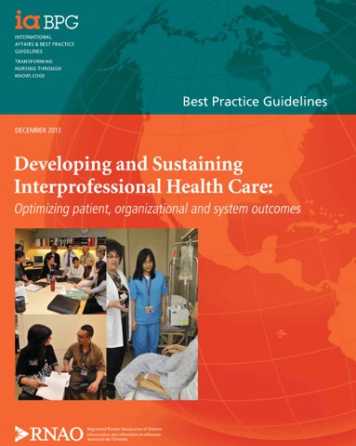
For the purpose of this document, Interprofessional is defined as: Multiple health disciplines with diverse knowledge and skills who share an integrated set of goals and who utilize interdependent collaboration that involves communication, sharing of knowledge and coordination of services to provide services to patients/clients and their care-giving systems. This best practice guideline, Developing and Sustaining Interprofessional Health Care: Optimizing patients/clients, organizational, and system outcomes is intended to foster healthy work environments. The focus in developing this guideline was identifying attributes of interprofessional care that will optimize quality outcomes for patients/clients, providers, teams, the organization and the system. This guideline identifies best practices to enable, enhance and sustain teamwork and interprofessional collaboration, and to enhance positive outcomes for patients/clients, systems and organizations. It is based on the best available evidence; where evidence was limited, the recommendations were based on the consensus of expert opinion. Registered Nurses’ Association of Ontario. (2013). Developing and sustaining interprofessional health care: Optimizing patients/clients, organizational, and systems outcomes. Toronto, ON: Author.    
External link
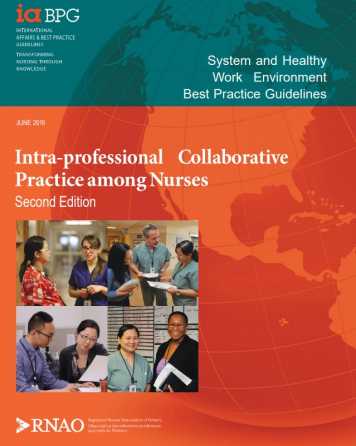
This guideline, is focused on collaborative practice amongst three types of nursing professionals – registered nurse (RN), registered practical nurse (RPN) and nurse practitioner (NP) – and explores what fosters healthy work environments for them, aware that collaboration must align with the needs of the patient or client. This best practice guideline was developed to assist nurses, nursing leaders, other health professionals and senior managers to enhance positive outcomes for patients/clients (individual/family/group/community), nurses, and the organization through intra-professional collaborative practice.  The guideline identifies- best practices for intra-professional practice; and the organizational culture, values and relationships, and the structures and processes required, for developing and sustaining effective intra-professional nursing practice among nurses. Reference: Registered Nurses’ Association of Ontario (2016). Intra-professional Collaborative Practice among Nurses. Toronto, ON. Author
External link
The purpose of this Guideline is to provide evidence-based recommendations that promote and sustain the undergraduate nursing student’s application of knowledge to practice in a variety of clinical learning environments. The Guideline explores the relationships among and between students and nursing educators, nursing staff, preceptors, and diverse health-care team members, and it considers their influence on the quality of practice education, professional socialization, and nursing excellence. Registered Nurses’ Association of Ontario (2016). Practice Education in Nursing. Toronto, ON. Author.
External link
This quick reference guide was created to support the uptake of the RNAO Best Practice Guideline Practice Education in Nursing. The full Guideline is available for free download from the RNAO website and this toolkit. This quick reference guide is targeted for nurses who are educators, preceptors, or mentors for undergraduate nursing students as a quick and easy way to review the Guideline recommendations. It will also be useful for educational institutions and service agencies implementing the Guideline. We encourage users of this quick reference guide to refer to the full Guideline for more complete and detailed information related to providing quality practice education for nursing students. Reference: Registered Nurses’ Association of Ontario (2016). Practice Education in Nursing. Toronto, ON. Author.
External link
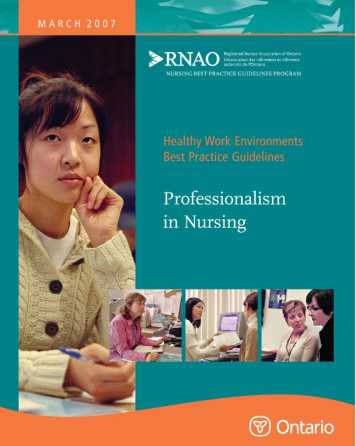
Learn to identify professional practices that enhance outcomes for nurses, the recipients of nursing services, organizations and systems. Through implementation of this guideline, you will learn: To identify the organizational culture, values and relationships and the structures and processes required for developing and sustaining effective professional practices Professional practice involves structures and processes needed to achieve outcomes. Ensuring professional practice standards involves being accountable to your workplace for your actions and the implementation of a high ethical standard. Through translating knowledge into action, professional practice standards are met. This guideline provides evidence-based recommendations for RNs and RPNs on best nursing practices for professionalism in nursing. Registered Nurses’ Association of Ontario. (2007). Professionalism in nursing. Toronto, ON, Canada: Author.
External link
The Registered Nurses' Association of Ontario (RNAO) RN Careers- The career site for nurses, website offers career opportunities and resources for job seekers, new nurses, mid and late career nurses and employers. © 2021 - 2025 RNAO
External link
This document defines scope of practice for regulated health professional, outlines controlled acts and identifies who is appropriate to perform controlled acts. © College of Nurses of Ontario, 2025
External link
The article highlights the basics of shared governance and how to establish committees and outlines the role of a quality committee. Reference: Ward. J. (nd) Retrieved from http://www.nursetogether.com/shared-governance-what-exactly-it © 2025 NurseTogether 

Implementation resources

Document
This table provides sample structure, process and outcome indicators which may be useful for organizations to measure their quality progress and change. Reference: Registered Nurses’ Association of Ontario (RNAO) (2016). Intra-professional Collaborative Practice among Nurses, Second Edition, pages 50 - 53. Toronto, Ontario: Registered Nurses’ Association of Ontario. 
External link
This guideline identifies best practices to enable, enhance and sustain teamwork and interprofessional collaboration, and to enhance positive outcomes for patients/clients, systems and organizations. It is based on the best available evidence; where evidence was limited, the recommendations were based on the consensus of expert opinion. Registered Nurses’ Association of Ontario. (2013). Developing and Sustaining Interprofessional health care. Toronto, ON. Author. 
External link
For the purpose of this document, Interprofessional is defined as: Multiple health disciplines with diverse knowledge and skills who share an integrated set of goals and who utilize interdependent collaboration that involves communication, sharing of knowledge and coordination of services to provide services to patients/clients and their care-giving systems. This best practice guideline, Developing and Sustaining Interprofessional Health Care: Optimizing patients/clients, organizational, and system outcomes is intended to foster healthy work environments. The focus in developing this guideline was identifying attributes of interprofessional care that will optimize quality outcomes for patients/clients, providers, teams, the organization and the system. This guideline identifies best practices to enable, enhance and sustain teamwork and interprofessional collaboration, and to enhance positive outcomes for patients/clients, systems and organizations. It is based on the best available evidence; where evidence was limited, the recommendations were based on the consensus of expert opinion. Registered Nurses’ Association of Ontario. (2013). Developing and sustaining interprofessional health care: Optimizing patients/clients, organizational, and systems outcomes. Toronto, ON: Author.    

Education resources

External link
The website gives an overview on the accreditation program for long-term care called Qmentum Global for Long-Term Care. Reference: Accreditation Canada (n.d.). Qmentum Global™ for Long-Term Care (accreditation.ca).    
External link
This website provides an overview of the Accreditation Canada program for long-term care called, Qmentum Global for Long-Term Care. Reference: Accreditation Canada (n.d.). Qmentum Global for Long-Term Care.  
External link
This article describes the results of a consultation facilitated during the June 2017 CNA annual meeting of members. It outlines some of the opportunities nurses have to provide input into future CNA initiatives on strengthening intra-professional collaboration. © Copyright 2025 Canadian Nurses Association
External link
CNA is the national professional voice of registered nurses in Canada. Representing nearly 139,000 registered nurses, CNA’s members include: Provincial and territorial nursing associations and colleges Independent RNs from Ontario and Quebec Retired nurses Canadian Nursing Students’ Association Canadian Network of Nursing Specialties © Copyright 2025 Canadian Nurses Association.
External link
There are nurse mentors throughout Canada who support and assist aspiring nurses through the Canadian Nurses Association (CNA) Certification Mentorship Program. Nurse mentors have current CNA certification and at least three years of experience in a nursing specialty. The toolkit offers guidance for the process. Revised December 2021
External link
This is a short and breezy introduction to coaching and the GROW model Reference: Heath, M. (2015) 
External link
This link takes you to the Canadian Nurses Association page that explains the Code of Ethics and the 7 values related to the nursing profession. © Copyright 2025 Canadian Nurses Association
External link
This document on a collaborative practice was created by three nursing regulatory bodies in Alberta.  The paper incorporates five principles that are believed to maximize client health-care outcomes and effective teamwork. The content is transferrable and relevant to nurses practicing in Ontario. 
External link
College of Nurses of Ontario- Code of Conduct for Nurses is a guide to support nurses with the professional practice standards by providing detailed guidance nurses require for safe and ethical care. The website includes information, the guiding document and related video.  © 2025 College of Nurses of Ontario  
External link
This College of Nurses of Ontario document defines scope of practice for nurses. July 2025  
External link
Findings from a quality improvement project which aimed to focused on understanding the problems related to information exchanges between nurses.  Christine Johnson, RN, MN, GNC(C), is a Clinical Nurse Specialist in the Rehab and Geriatric Program, Health Sciences Centre, Winnipeg. Tricia Carta, RN, MN, is a Clinical Nurse Specialist in the Burn Program, Health Sciences Centre. Karen Throndson, RN, MN, is a Clinical Nurse Specialist in the Cardiac Program, Health Sciences Centre.
External link
This tips and tools guide is designed to assist you to better understand and learn how to plan, provide, develop and sustain interprofessional health care in your work environment. Registered Nurses of Ontario ( 2013) Developing and Sustaining Interprofessional Health Care: Tips and Tools for Health-care Teams, Toronto. ON.  
External link
This tips and tools guide is designed to assist you to better understand and learn how to plan, provide, develop and sustain interprofessional health care in your work environment. The information contained in this guide is based on the RNAO Healthy Work Environment Best Practice Guideline: Developing and Sustaining Interprofessional Health Care: Optimizing Patient, Organizational and Systems Outcomes and includes an Interprofessional Competency Framework Self-Assessment Tool.  
External link
Les présentes lignes directrices sur les pratiques exemplaires, Développement et maintien des soins de santé interprofessionnels : optimisation des résultats pour le patient/client, l’organisme et le système sont conçues pour favoriser des milieux de travail sains. Les présentes lignes directrices déterminent les pratiques exemplaires pour faciliter, améliorer et maintenir le travail d’équipe ainsi que la collaboration interprofessionnelle, et pour accroître les résultats positifs pour les patients/clients, les systèmes et les organisations. Association des infirmières et infirmiers autorisés de l’Ontario. (2013). Développement et maintien des soins de santé interprofessionnels : optimisation des résultats pour le patient/client, l’organisme et le système. Toronto, Canada: Autheur.      
External link
This HelpGuide.org resource addresses being a good listener, nonverbal signal, keep stress in check and how to assert yourself. ©1999-2025 HelpGuide.org
External link
Healthy Workforce Institute provides scripts healthcare leaders can use when addressing unprofessional behaviours. Eight common disruptive situations are provided followed with scripts on how to handle them. © 2025 Healthy Workforce Institute®
External link
Health Force Ontario is the province’s strategy to ensure that Ontarians have access to the right number and mix of qualified health care providers, now and in the future. Included on the site is information about the Nursing Graduate Guarantee Initiative. © King's Printer for Ontario, 2025 
External link
Each of RNAO’s interest groups represents a unique specialty or population within the nursing spectrum. Together they illustrate the remarkable diversity of the profession. They offer a range of professional resources and support, both personal and sometimes financial, through bursaries and awards.The Registered Nurses' Association of Ontario (RNAO) offers many money-saving benefits that can more than offset your membership fees. RNAO members benefit from membership in a variety of ways. Through conferences, institutes, interest groups, online communities and chapter activities, RNAO provides knowledge-rich, exclusive networking opportunities for members to cultivate rewarding personal and professional relationships. Registered Nurses Association of Ontario. Special Interest Group. Toronto, ON, Canada. 
External link
The brief and general introduction examines what communities of practice are and identifies 3 crucial characteristics. Many other examples of CoPs are also available Reference: Wenger-Trayner, E., & Wenger-Trayner B.(2015).   
External link
A series of 2-minute videos promoting kindness in the workplace by Renee Thompson. The focus is on helping people to be kind, cope and care with the challenges of the workplace.  
External link
The Nursing Act establishes the mandate of the College of Nurses of Ontario and defines a scope of practice for the nursing profession College of Nurses of Ontario Feb 2025 03 02
External link
Renee Thompson, Registered Nurse, has a series of short videos on nurse bullying with practical strategies for addressing nurse bullying and behaviour change for a healthy workplace. Reference: Thompson, R (2021). Nurse Bullying: Coffee and Conversation. © 2025 Healthy Workforce Institute®
External link
This 3-minute video by Renee Thompson, discusses bullying and incivility and emphasizes that workplace culture is everyone's responsibility. Reference: Thompson, R (2021).  © 2025 Healthy Workforce Institute®
External link
The Nurse Practitioner practice standard outlines the accountabilities specific to Nurse Practitioners (NPs) in Ontario, also referred to as Registered Nurses in the Extended Class. NPs are also responsible for adhering to all relevant legislation, as well as other applicable CNO standards and guidelines. © College of Nurses of Ontario, 2025
External link
Website for the Nurse Practitioners' Association of Ontario which represents nurse practitioners in all levels of health care: primary, secondary and tertiary care. 
External link
Ontario Personal Support Worker Association (OPSWA) website provides access to information, resources and tools to help PSWs do their job better and with more confidence.  
External link
Intra-professional collaboration, is a position paper issued by the Canadian Nurses' Association which outlines their position, values and beliefs on the obligation and concepts a regulated nurse must meet to achieve an intra-professional practice. Canadian Nurses' Association (2020)  
External link
The Preceptor Education Program is an online interprofessional program that consists of nine interactive learning modules. The modules include downloadable resources, learning exercises, video case scenarios and references. Learning is self-directed in that modules are self-directed and do not need to be completed in any particular order. Many of the modules are designed so that preceptors and students can work through them together. After completing a reflective note, a certificate can be printed at the end of each module to record the education completed. Reference: Kinsella, E.A., Bossers, A., Ferguson, K., Jenkins, K., Bezzina, M.B., MacPhail, A., Moosa, T., Schurr, S., Whitehead, J. & Hobson, S. (2016). Preceptor Education Program for health professionals and students. (2nd ed.) London, ON: The University of Western Ontario. Retrieved from: www.preceptor.ca
External link
The Registered Nurses’ Association of Ontario (RNAO) is the professional association representing registered nurses, nurse practitioners and nursing students in Ontario. The site provides information about membership, best practice guidelines, policy/political action and events. © 2025 RNAO. All rights reserved.
External link
The Registered Practical Nurses Association of Ontario (WeRPN) website, has information about membership, education, advocacy, research and events for RPNs.   
External link
Developed through a national advisory group and broad consultation, this framework supports RNs in collaborating with partners to plan a health-care system that reflects the needs and priorities of Canadians. © Copyright 2025 Canadian Nurses Association
External link
This guideline, is focused on collaborative practice amongst three types of nursing professionals – registered nurse (RN), registered practical nurse (RPN) and nurse practitioner (NP) – and explores what fosters healthy work environments for them, aware that collaboration must align with the needs of the patient or client. This best practice guideline was developed to assist nurses, nursing leaders, other health professionals and senior managers to enhance positive outcomes for patients/clients (individual/family/group/community), nurses, and the organization through intra-professional collaborative practice.  The guideline identifies- best practices for intra-professional practice; and the organizational culture, values and relationships, and the structures and processes required, for developing and sustaining effective intra-professional nursing practice among nurses. Reference: Registered Nurses’ Association of Ontario (2016). Intra-professional Collaborative Practice among Nurses. Toronto, ON. Author
External link
The purpose of this Guideline is to provide evidence-based recommendations that promote and sustain the undergraduate nursing student’s application of knowledge to practice in a variety of clinical learning environments. The Guideline explores the relationships among and between students and nursing educators, nursing staff, preceptors, and diverse health-care team members, and it considers their influence on the quality of practice education, professional socialization, and nursing excellence. Registered Nurses’ Association of Ontario (2016). Practice Education in Nursing. Toronto, ON. Author.
External link
This quick reference guide was created to support the uptake of the RNAO Best Practice Guideline Practice Education in Nursing. The full Guideline is available for free download from the RNAO website and this toolkit. This quick reference guide is targeted for nurses who are educators, preceptors, or mentors for undergraduate nursing students as a quick and easy way to review the Guideline recommendations. It will also be useful for educational institutions and service agencies implementing the Guideline. We encourage users of this quick reference guide to refer to the full Guideline for more complete and detailed information related to providing quality practice education for nursing students. Reference: Registered Nurses’ Association of Ontario (2016). Practice Education in Nursing. Toronto, ON. Author.
External link
Learn to identify professional practices that enhance outcomes for nurses, the recipients of nursing services, organizations and systems. Through implementation of this guideline, you will learn: To identify the organizational culture, values and relationships and the structures and processes required for developing and sustaining effective professional practices Professional practice involves structures and processes needed to achieve outcomes. Ensuring professional practice standards involves being accountable to your workplace for your actions and the implementation of a high ethical standard. Through translating knowledge into action, professional practice standards are met. This guideline provides evidence-based recommendations for RNs and RPNs on best nursing practices for professionalism in nursing. Registered Nurses’ Association of Ontario. (2007). Professionalism in nursing. Toronto, ON, Canada: Author.
External link
The Registered Nurses' Association of Ontario (RNAO) RN Careers- The career site for nurses, website offers career opportunities and resources for job seekers, new nurses, mid and late career nurses and employers. © 2021 - 2025 RNAO
External link
This document defines scope of practice for regulated health professional, outlines controlled acts and identifies who is appropriate to perform controlled acts. © College of Nurses of Ontario, 2025
External link
The article highlights the basics of shared governance and how to establish committees and outlines the role of a quality committee. Reference: Ward. J. (nd) Retrieved from http://www.nursetogether.com/shared-governance-what-exactly-it © 2025 NurseTogether 

Evaluation resources

There are no evaluation resources available for this topic.

BPG appendices