

Image

On this page: This year's winners | Award categories | Eligibility | Additional rules
Hosted by RNAO, the annual Media Awards honours journalists for their outstanding reporting on nursing and health-care issues.
Stories published or broadcast in Ontario during 2025 are eligible. Entries are scored by an independent panel of judges consisting of nurses and journalists.
The competition is limited to one entry per person. Entrants may not submit a single entry to multiple categories. For more information, please read our eligibility and rules below.
Status: Closed

After studying journalism at Niagara College, Nick Fearns began his reporting career immediately after graduation with the Macklin Mirror in Macklin, Saskatchewan. He later returned to the Niagara region, where he worked for Niagara This Week, writing for seven different newspapers across the area.

Natasha Baldin is a reporter with the Ottawa Citizen, where she covers stories ranging from municipal affairs, public safety, women’s sports and other human-centred stories that reflect the everyday experiences of residents. Raised in Ottawa, she double majored in journalism and linguistics at Carleton University. Her reporting has brought her across the country while working for publications including The Canadian Press and Victoria News.

Wendy Glauser is a freelance writer who has written about health and science in Canada and internationally for 20 years. She reports with a deep respect for health-care workers and a firm belief in the need to protect and improve our public health system.

Olivia Bowden is a Toronto-based freelance journalist who primarily covers health, race and social justice. As an independent journalist, she currently writes for The Guardian and other local outlets. She also is a part-time producer at Global News. Previously, she worked for CBC News as a TV, web and radio reporter, along with the Toronto Star and CTV News.

Blair Bigham is an award-winning journalist, scientist and physician who trained in emergency and critical care medicine at McMaster and Stanford Universities. He was a Global Journalism Fellow at the Munk School of Global Affairs and associate scientist at St Michael’s Hospital before joining the faculty of the Dalla Lana School of Public Health at the University of Toronto. His work has appeared in newspapers, magazines, newscasts, podcasts and medical journals.

Démar Grant is the culture reporter for the Hamilton Spectator, who’s also been nominated for a 2026 Canadian Association of Journalists Award. Prior to that, he was a reporter for the Investigative Journalism Bureau via the 2024 Canadian Journalism Foundation Black Investigative Journalism Fellowship.
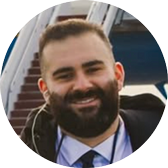
Julian Abraham is an audio reporter with Canadaland in Toronto. He started his journalism career at CTV Atlantic in Halifax in 2015 while still a student. He has three university degrees: a Bachelor of Arts in Criminology from Saint Mary's University, a Bachelor of Journalism from the University of King's College in Halifax, and a Master of Science from Columbia Journalism School in New York.

Heather Butts is the Weekend Anchor for CTV National News, hosting the network’s early and late evening newscasts. She has been part of the CTV News team since 2014, serving in multiple roles at stations across Canada.
In these categories, entries will be judged on news value, information and storytelling.
| Category | Awards |
|---|---|
| Daily newspaper | Best news story |
| Community newspaper |
|
| Radio | |
| Television |
|
| Online | Best news story |
| Podcast | |
| Multicultural |
How to apply

For print entries, please send PDF scans of the original article. Please also include a link if the story appears online.

For broadcast submissions, links and/or electronic audio or video files are preferred.
Contact us
RNAO will present the awards to this year’s winners during a virtual gathering in June 2026.
For more information, contact Victoria Alarcon at 1-800-268-7199 ext. 211 and Marion Zych at 1-800-268-7199 ext. 209.
Entries must be from an established media outlet that publishes at least five times a week. Limited to one story.
Entries must be from an established media outlet that publishes at least five times a week and consists of one feature story or a series of stories that clearly outlines the sequence/order (maximum five parts).
Entries must be from an established media outlet that publishes at least once or twice a week. Limited to one story.
Entries must be from an established media outlet that publishes at least once or twice a week and consists of one feature story or a series of stories that clearly outlines the sequence/order (maximum five parts).
Entries must be from an established media outlet. Limited to one radio report.
Entries must be from an established media outlet. Limited to one radio documentary or a series that clearly outlines the sequence/order (maximum five parts).
Entries must be from an established media outlet. Limited to one television report.
Entries must be from an established media outlet. Limited to one television documentary or a series that clearly outlines the sequence/order (maximum five parts).
Entries must be from an established media outlet website. Limited to one story.
Entries must be from an established media outlet website that consists of one feature story or a series of stories that clearly outlines the sequence/order (maximum five parts).
Entries must be from an established media outlet. Limited to one episode on a single topic that is one hour or less.
Entries must be from an established media outlet. Limited to a series of episodes on a single topic that clearly outlines the sequence/order (maximum five parts).
Entries must be from an established media outlet website and in a language other than English. Limited to one story.
Entries must be from an established media outlet website and in a language other than English that consists of one feature story or a series of stories that clearly outlines the sequence/order (maximum five parts).

© 2026 RNAO. All rights reserved.