


Pain
Provides tools and strategies for identifying, assessing, and managing pain in LTC residents. Includes validated assessment tools, care planning resources, and staff training materials.
Related Guideline
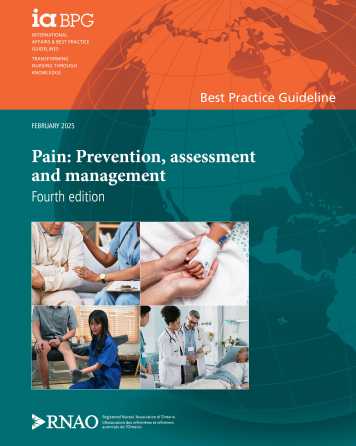
Pain: Prevention, assessment and management, Fourth edition
The purpose of this fourth edition guideline is to provide nurses and the interprofessional team with evidence-based guidance for the prevention, assessment, and management of all types of pain across the lifespan.
All resources
 External link
The Abbey Pain Scale is an instrument designed to assist in the assessment of pain in patients who are unable to clearly articulate their needs, for example, patients with dementia, cognition or communication issues. The scale does not differentiate between distress and pain, so measuring the effectiveness of pain-relieving interventions is essential.
Abbey, J; De Bellis, A; Piller, N; Esterman, A; Giles, L; Parker, D and Lowcay, B. Funded by the JH & JD Gunn Medical Research Foundation 1998 – 2002. This document may be reproduced with this acknowledgment retained.
 Document
A list of organization and resources for pain prevention, assessment and management.
Reference: Registered Nurses’ Association of Ontario. (2025). Appendix F of Pain: Prevention, assessment and management. (Fourth Ed.). Toronto, ON: Author. pp. 97.
External linkPurpose of the BPI tool is to assess the severity of pain and the impact of pain on daily functions. The tool can be used for patients with pain from chronic diseases or conditions such as cancer, osteoarthritis and low back pain, or with pain from acute conditions such as postoperative pain.
Assessment areas included are severity of pain, impact of pain on daily function, location of pain, pain medications and amount of pain relief in the past 24 hours or the past week.
The BPI copyright is held by Dr Charles S. Cleeland (1991). The copyright applies to the BPI and all it's derivatives in any language.
External linkThe Canadian Journal of Pain is an open access journal that publishes research from all disciplines involved in the study of pain, including the clinical and basic sciences, epidemiology, and health policy and health systems. The Canadian Journal of Pain is the Official Journal of the Canadian Pain Society.
The journal aims to advance the understanding and treatment of pain by providing clinicians, scientists and other health care professionals with an interdisciplinary forum in which to share cutting-edge information about new developments in the field of pain, including chronic and neuropathic pain.
The journal operates a single anonymized peer review policy. Source: Canadian Journal of Pain. Copyright © 2025 Inform UK Limited
External linkThe Checklist of Nonverbal Pain Indicators (CNPI), was designed to observe and measure pain behaviors in cognitively impaired elders.
Feldt KS. The checklist of nonverbal pain indicators (CNPI). Pain Manag Nurs. 2000 Mar;1(1):13-21. Horgas AL. Assessing pain in persons with dementia. In: Boltz M, series ed. Try This: Best Practices in Nursing Care for Hospitalized Older Adults with Dementia. 2003 Fall;1(2). The Hartford Institute for Geriatric Nursing.
DocumentThis tool demonstrates how the mnemonic OPQRSTUV, can be used to conduct a comprehensive pain assessment. Note that this assessment may not be the most appropriate tool for all presentations of pain.
Reference: Registered Nurses’ Association of Ontario. (2025). Appendix C of Pain: Prevention, assessment and management. (Fourth Ed.). Toronto, ON: Author. pp. 81.
Source: Adapted from: Fraser Health. Hospice palliative care program: symptom guidelines [Internet]. Surrey (BC): Fraser Health; 2019.
External linkThis tool demonstrates how the mnemonic OPQRSTUV, can be used to conduct a comprehensive pain assessment. Note that this assessment may not be the most appropriate tool for all presentations of pain.
Reference: Registered Nurses’ Association of Ontario. (2025). Appendix C of Pain: Prevention, assessment and management. (Fourth Ed.). Toronto, ON: Author. pp. 81.
Source: Adapted from: Fraser Health. Hospice palliative care program: symptom guidelines [Internet]. Surrey (BC): Fraser Health; 2019.
DocumentThe Leading Change Toolkit includes two frameworks- the Social Movement Action (SMA) Framework and the Knowledge-to-Action (KTA) Framework. Both frameworks outline the concept of implementation and its interrelated components. The toolkit is based on available evidence, theoretical perspectives and consensus. We recommend the Leading Change Toolkit for guiding the implementation of any BPG in health care or social service organizations, including academic centres.
Reference: Registered Nurses’ Association of Ontario, (2025). Appendix G of Pain: prevention, assessment and management. Fourth edition. Toronto, Canada: Author. pp. 98-99 .
External linkThe Leading Change Toolkit includes two frameworks- the Social Movement Action (SMA) Framework and the Knowledge-to-Action (KTA) Framework. Both frameworks outline the concept of implementation and its interrelated components. The toolkit is based on available evidence, theoretical perspectives and consensus. We recommend the Leading Change Toolkit for guiding the implementation of any BPG in health care or social service organizations, including academic centres.
Reference: Registered Nurses’ Association of Ontario, (2025). Appendix G of Pain: prevention, assessment and management. Fourth edition. Toronto, Canada: Author. pp. 98-99 .
External linkThe revised ESAS-r is available in multiple languages. The link will take you to the guidelines for using the ESAS-r tool. The ESAS-r tool is freely available to use, with appropriate acknowledgement of its source.
Last revised: November 2019
External linkYou may need to seek assistance from a health-care professional when you have concerns about people you care for who are in pain. Uncontrolled pain is a common problem. Pain can affect anyone at any age and include people who are unable to communicate that they are experiencing some form of pain. If people have pain during their day-to-day activities or during any medical procedure, this can affect the way they behave and function. This behaviour may cause you to feel helpless and distressed, especially if you can not help them with their pain and they are not able to speak for themselves.
External linkManagement of Chronic Non-Cancer Pain – Center for Effective Practice- “This tool is designed to help family physicians and nurse practitioners (primary care providers) develop and implement a management plan for adult patients with chronic non-cancer pain (CNCP). This tool applies to, but is not limited to pain conditions such as osteoarthritis, low back pain, musculoskeletal pain, fibromyalgia and neuropathic pain.”
Updated May 2018
DocumentPACSLAC is a tool to observe and assess both common and subtle pain behaviours. Copyright © Shannon Fuchs-Lacelle and Thomas Hadjistavropoulos. The PACSLAC may not be reproduced without permission. For permission to reproduce the PACSLAC, please contact the copyright holders ([email protected]).
External linkPain Matters was created with brainXchange and the Alzheimer Society of Ontario to assist family, friends and caregivers of people with dementia to recognize the relationship between pain and responsive behaviour. Behaviour has meaning and it may be an expression of pain.
© 2025 brainXchange™
DocumentThese pain screening and assessment tools can be self-reported (by the individual experiencing pain and/or their family) or observational (behaviours observed by a health provider in an individual who is unable to communicate or is unconscious). This is a list of validated tools that can be used to assess pain in various populations and contexts. However, this is not an exhaustive list. Please follow organizational policies for pain tool usage. Not all tools are validated for all populations and settings. RNAO does not endorse the use of any one specific pain screening and assessment tool.
Reference: Registered Nurses’ Association of Ontario. (2025). Appendix D of Pain: Prevention, assessment and management. (Fourth Ed.). Toronto, ON: Author.
External linkThese pain screening and assessment tools can be self-reported (by the individual experiencing pain and/or their family) or observational (behaviours observed by a health provider in an individual who is unable to communicate or is unconscious). This is a list of validated tools that can be used to assess pain in various populations and contexts. However, this is not an exhaustive list. Please follow organizational policies for pain tool usage. Not all tools are validated for all populations and settings. RNAO does not endorse the use of any one specific pain screening and assessment tool.
Reference: Registered Nurses’ Association of Ontario. (2025). Appendix D of Pain: Prevention, assessment and management. (Fourth Ed.). Toronto, ON: Author.
DocumentA tool to assist with comparing your organization’s current practice with evidence-based RNAO best practice recommendations.
Registered Nurses Association of Ontario (2025). Opportunity Analysis: Pain: Prevention, assessment & management, Fourth Ed. Toronto, ON.
External linkThis link takes you to PARC which supports, educates and informs persons with Reflex Sympathetic Dystrophy (RSD), otherwise known as Complex Regional Pain Syndrome (CRPS) the community and the medical professionals treating RSD, about the importance of early diagnosis and treatment.
Copyright © 2002-2022 The P.A.R.C
External linkThe Pasero Opioid-induced Sedation Scale (POSS) can be used to assess and monitor sedation levels in residents receiving opioid therapy, helping to prevent over-sedation and respiratory depression. The POSS helps healthcare providers balance pain relief with safety, reducing the risk of opioid-induced respiratory depression. It should be used alongside other assessments like respiratory rate and pain scores.
External linkThis Best Practice Guideline (BPG) Pain: Prevention, assessment and management (Fourth Ed.), replaces the RNAO BPG Assessment and Management of Pain, Third Edition.
The purpose of this fourth edition guideline is to provide nurses and the interprofessional team with evidence-based guidance for the prevention, assessment and management of all types of pain across the lifespan. This BPG recognizes that people at risk of or experiencing any type of pain across the lifespan and their families are experts in their health and decision-making; collaboration among the interprofessional team, the person receiving care and their family (if applicable) is therefore essential to achieving improved health outcomes.
Registered Nurses’ Association of Ontario. (2025). Pain: Prevention, assessment and management. (Fourth Ed.). Toronto, ON,
This work is funded by the Ontario Ministry of Health and Long-Term Care.
External linkA list topics and suggested RNAO guidelines and resources from other organizations that align with Pain: Prevention, assessment and management. Fourth edition. Toronto, Canada: Author. pp. 76-78.
Reference: Registered Nurses’ Association of Ontario. (2025). Appendix B of Pain: Prevention, assessment and management. (Fourth Ed.). Toronto, ON: Author.
DocumentA list topics and suggested RNAO guidelines and resources from other organizations that align with Pain: Prevention, assessment and management. Fourth edition. Toronto, Canada: Author. pp. 76-78.
Reference: Registered Nurses’ Association of Ontario. (2025). Appendix B of Pain: Prevention, assessment and management. (Fourth Ed.). Toronto, ON: Author.
External linkA number of systematic reviews focused on non-pharmacological approaches (NPI) to pain management: Type of NPI and population.
Reference: Registered Nurses’ Association of Ontario. (2025). Appendix E of Pain: Prevention, assessment and management. (Fourth Ed.). Toronto, ON: Author. pp. 89-96
DocumentA number of systematic reviews focused on non-pharmacological approaches (NPI) to pain management: Type of NPI and population.
Reference: Registered Nurses’ Association of Ontario. (2025). Appendix E of Pain: Prevention, assessment and management. (Fourth Ed.). Toronto, ON: Author. pp. 89-96
DocumentSymptom Management Algorithm can be used to perform a clinical assessment related to pain for adults diagnosed with cancer.
Cancer Care Ontario (2018) Symptom Management Algorithm- Pain in Adults with Cancer.
Implementation resources
External linkThe Abbey Pain Scale is an instrument designed to assist in the assessment of pain in patients who are unable to clearly articulate their needs, for example, patients with dementia, cognition or communication issues. The scale does not differentiate between distress and pain, so measuring the effectiveness of pain-relieving interventions is essential.
Abbey, J; De Bellis, A; Piller, N; Esterman, A; Giles, L; Parker, D and Lowcay, B. Funded by the JH & JD Gunn Medical Research Foundation 1998 – 2002. This document may be reproduced with this acknowledgment retained.
External linkPurpose of the BPI tool is to assess the severity of pain and the impact of pain on daily functions. The tool can be used for patients with pain from chronic diseases or conditions such as cancer, osteoarthritis and low back pain, or with pain from acute conditions such as postoperative pain.
Assessment areas included are severity of pain, impact of pain on daily function, location of pain, pain medications and amount of pain relief in the past 24 hours or the past week.
The BPI copyright is held by Dr Charles S. Cleeland (1991). The copyright applies to the BPI and all it's derivatives in any language.
External linkThe Canadian Journal of Pain is an open access journal that publishes research from all disciplines involved in the study of pain, including the clinical and basic sciences, epidemiology, and health policy and health systems. The Canadian Journal of Pain is the Official Journal of the Canadian Pain Society.
The journal aims to advance the understanding and treatment of pain by providing clinicians, scientists and other health care professionals with an interdisciplinary forum in which to share cutting-edge information about new developments in the field of pain, including chronic and neuropathic pain.
The journal operates a single anonymized peer review policy. Source: Canadian Journal of Pain. Copyright © 2025 Inform UK Limited
External linkThe Checklist of Nonverbal Pain Indicators (CNPI), was designed to observe and measure pain behaviors in cognitively impaired elders.
Feldt KS. The checklist of nonverbal pain indicators (CNPI). Pain Manag Nurs. 2000 Mar;1(1):13-21. Horgas AL. Assessing pain in persons with dementia. In: Boltz M, series ed. Try This: Best Practices in Nursing Care for Hospitalized Older Adults with Dementia. 2003 Fall;1(2). The Hartford Institute for Geriatric Nursing.
External linkThe revised ESAS-r is available in multiple languages. The link will take you to the guidelines for using the ESAS-r tool. The ESAS-r tool is freely available to use, with appropriate acknowledgement of its source.
Last revised: November 2019
External linkYou may need to seek assistance from a health-care professional when you have concerns about people you care for who are in pain. Uncontrolled pain is a common problem. Pain can affect anyone at any age and include people who are unable to communicate that they are experiencing some form of pain. If people have pain during their day-to-day activities or during any medical procedure, this can affect the way they behave and function. This behaviour may cause you to feel helpless and distressed, especially if you can not help them with their pain and they are not able to speak for themselves.
External linkManagement of Chronic Non-Cancer Pain – Center for Effective Practice- “This tool is designed to help family physicians and nurse practitioners (primary care providers) develop and implement a management plan for adult patients with chronic non-cancer pain (CNCP). This tool applies to, but is not limited to pain conditions such as osteoarthritis, low back pain, musculoskeletal pain, fibromyalgia and neuropathic pain.”
Updated May 2018
DocumentPACSLAC is a tool to observe and assess both common and subtle pain behaviours. Copyright © Shannon Fuchs-Lacelle and Thomas Hadjistavropoulos. The PACSLAC may not be reproduced without permission. For permission to reproduce the PACSLAC, please contact the copyright holders ([email protected]).
External linkThe Pasero Opioid-induced Sedation Scale (POSS) can be used to assess and monitor sedation levels in residents receiving opioid therapy, helping to prevent over-sedation and respiratory depression. The POSS helps healthcare providers balance pain relief with safety, reducing the risk of opioid-induced respiratory depression. It should be used alongside other assessments like respiratory rate and pain scores.
External linkThis Best Practice Guideline (BPG) Pain: Prevention, assessment and management (Fourth Ed.), replaces the RNAO BPG Assessment and Management of Pain, Third Edition.
The purpose of this fourth edition guideline is to provide nurses and the interprofessional team with evidence-based guidance for the prevention, assessment and management of all types of pain across the lifespan. This BPG recognizes that people at risk of or experiencing any type of pain across the lifespan and their families are experts in their health and decision-making; collaboration among the interprofessional team, the person receiving care and their family (if applicable) is therefore essential to achieving improved health outcomes.
Registered Nurses’ Association of Ontario. (2025). Pain: Prevention, assessment and management. (Fourth Ed.). Toronto, ON,
This work is funded by the Ontario Ministry of Health and Long-Term Care.
DocumentSymptom Management Algorithm can be used to perform a clinical assessment related to pain for adults diagnosed with cancer.
Cancer Care Ontario (2018) Symptom Management Algorithm- Pain in Adults with Cancer.
Education resources
External linkPain Matters was created with brainXchange and the Alzheimer Society of Ontario to assist family, friends and caregivers of people with dementia to recognize the relationship between pain and responsive behaviour. Behaviour has meaning and it may be an expression of pain.
© 2025 brainXchange™
External linkThis link takes you to PARC which supports, educates and informs persons with Reflex Sympathetic Dystrophy (RSD), otherwise known as Complex Regional Pain Syndrome (CRPS) the community and the medical professionals treating RSD, about the importance of early diagnosis and treatment.
Copyright © 2002-2022 The P.A.R.C
Evaluation resources
There are no evaluation resources available for this topic.
BPG appendices
DocumentA list of organization and resources for pain prevention, assessment and management.
Reference: Registered Nurses’ Association of Ontario. (2025). Appendix F of Pain: Prevention, assessment and management. (Fourth Ed.). Toronto, ON: Author. pp. 97.
DocumentThis tool demonstrates how the mnemonic OPQRSTUV, can be used to conduct a comprehensive pain assessment. Note that this assessment may not be the most appropriate tool for all presentations of pain.
Reference: Registered Nurses’ Association of Ontario. (2025). Appendix C of Pain: Prevention, assessment and management. (Fourth Ed.). Toronto, ON: Author. pp. 81.
Source: Adapted from: Fraser Health. Hospice palliative care program: symptom guidelines [Internet]. Surrey (BC): Fraser Health; 2019.
External linkThis tool demonstrates how the mnemonic OPQRSTUV, can be used to conduct a comprehensive pain assessment. Note that this assessment may not be the most appropriate tool for all presentations of pain.
Reference: Registered Nurses’ Association of Ontario. (2025). Appendix C of Pain: Prevention, assessment and management. (Fourth Ed.). Toronto, ON: Author. pp. 81.
Source: Adapted from: Fraser Health. Hospice palliative care program: symptom guidelines [Internet]. Surrey (BC): Fraser Health; 2019.
DocumentThe Leading Change Toolkit includes two frameworks- the Social Movement Action (SMA) Framework and the Knowledge-to-Action (KTA) Framework. Both frameworks outline the concept of implementation and its interrelated components. The toolkit is based on available evidence, theoretical perspectives and consensus. We recommend the Leading Change Toolkit for guiding the implementation of any BPG in health care or social service organizations, including academic centres.
Reference: Registered Nurses’ Association of Ontario, (2025). Appendix G of Pain: prevention, assessment and management. Fourth edition. Toronto, Canada: Author. pp. 98-99 .
External linkThe Leading Change Toolkit includes two frameworks- the Social Movement Action (SMA) Framework and the Knowledge-to-Action (KTA) Framework. Both frameworks outline the concept of implementation and its interrelated components. The toolkit is based on available evidence, theoretical perspectives and consensus. We recommend the Leading Change Toolkit for guiding the implementation of any BPG in health care or social service organizations, including academic centres.
Reference: Registered Nurses’ Association of Ontario, (2025). Appendix G of Pain: prevention, assessment and management. Fourth edition. Toronto, Canada: Author. pp. 98-99 .
DocumentThese pain screening and assessment tools can be self-reported (by the individual experiencing pain and/or their family) or observational (behaviours observed by a health provider in an individual who is unable to communicate or is unconscious). This is a list of validated tools that can be used to assess pain in various populations and contexts. However, this is not an exhaustive list. Please follow organizational policies for pain tool usage. Not all tools are validated for all populations and settings. RNAO does not endorse the use of any one specific pain screening and assessment tool.
Reference: Registered Nurses’ Association of Ontario. (2025). Appendix D of Pain: Prevention, assessment and management. (Fourth Ed.). Toronto, ON: Author.
External linkThese pain screening and assessment tools can be self-reported (by the individual experiencing pain and/or their family) or observational (behaviours observed by a health provider in an individual who is unable to communicate or is unconscious). This is a list of validated tools that can be used to assess pain in various populations and contexts. However, this is not an exhaustive list. Please follow organizational policies for pain tool usage. Not all tools are validated for all populations and settings. RNAO does not endorse the use of any one specific pain screening and assessment tool.
Reference: Registered Nurses’ Association of Ontario. (2025). Appendix D of Pain: Prevention, assessment and management. (Fourth Ed.). Toronto, ON: Author.
External linkA list topics and suggested RNAO guidelines and resources from other organizations that align with Pain: Prevention, assessment and management. Fourth edition. Toronto, Canada: Author. pp. 76-78.
Reference: Registered Nurses’ Association of Ontario. (2025). Appendix B of Pain: Prevention, assessment and management. (Fourth Ed.). Toronto, ON: Author.
DocumentA list topics and suggested RNAO guidelines and resources from other organizations that align with Pain: Prevention, assessment and management. Fourth edition. Toronto, Canada: Author. pp. 76-78.
Reference: Registered Nurses’ Association of Ontario. (2025). Appendix B of Pain: Prevention, assessment and management. (Fourth Ed.). Toronto, ON: Author.
External linkA number of systematic reviews focused on non-pharmacological approaches (NPI) to pain management: Type of NPI and population.
Reference: Registered Nurses’ Association of Ontario. (2025). Appendix E of Pain: Prevention, assessment and management. (Fourth Ed.). Toronto, ON: Author. pp. 89-96
DocumentA number of systematic reviews focused on non-pharmacological approaches (NPI) to pain management: Type of NPI and population.
Reference: Registered Nurses’ Association of Ontario. (2025). Appendix E of Pain: Prevention, assessment and management. (Fourth Ed.). Toronto, ON: Author. pp. 89-96
