

International Day for the Elimination of Racial Discrimination
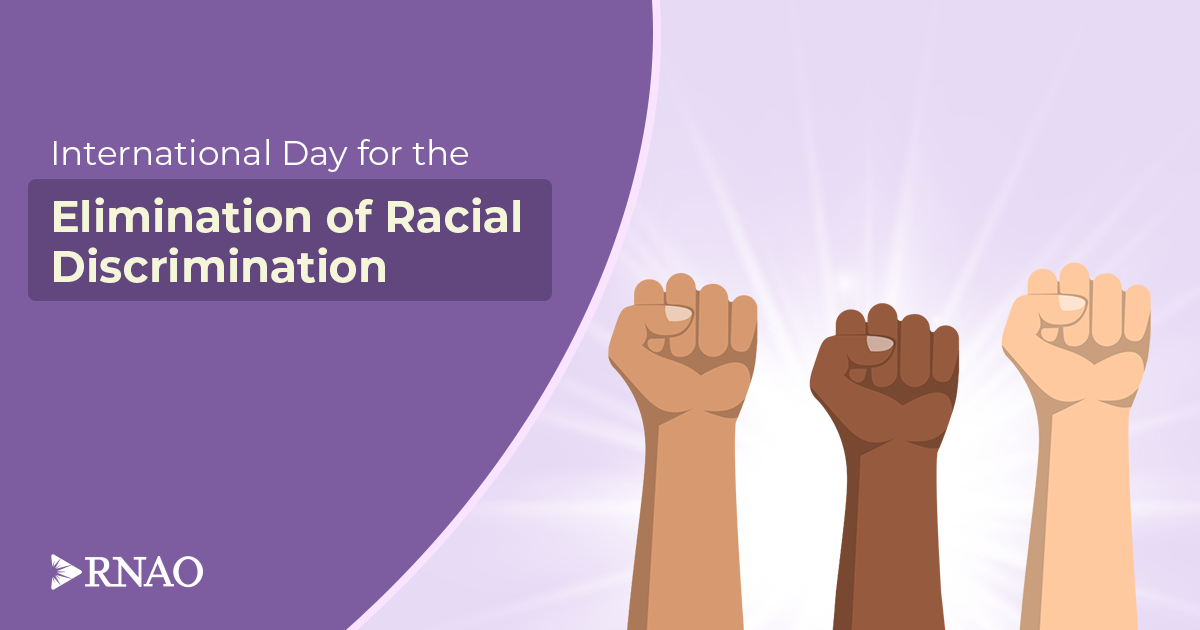
On this International Day for the Elimination of Racism, RNAO honours the courage of those who challenge injustice. RNAO remains steadfast in its condemnation of racism and discrimination in all its forms, advocating alongside elected officials, health organizations, and the public to dismantle systemic racism with all its intersectionality – both inside and outside the health system.
Consistent with this commitment to dismantling racism and discrimination, RNAO launched the trailblazing Addressing Anti‑Black Racism in Nursing best practice guideline on Feb. 26, advancing equity, diversity and inclusion (EDI) and amplifying voices of Black nurses and Black nursing students.
Significant groundwork for this guideline was laid by the Black Nurses Task Force (BNTF), established in 2020 to address anti-Black racism and discrimination in nursing. The task force outlined 19 recommendations in an impactful 2022 report, Acknowledging, Addressing and Tackling Anti-Black Racism and Discrimination Within the Nursing Profession – recommendations which since have guided action.
RNAO’s Health Equity Consortium – a joint effort of the Black Nurses Leading Change Interest Group, the Indigenous Nurses and Allies Interest Group, and the Rainbow Nursing Interest Group – was formed in 2022. The consortium illuminates lived experiences of discrimination and advances collective, intersectional and evidence-informed responses for Black, Indigenous and 2SLGBTQIA+ nurses, as described in its peer-reviewed article in the Canadian Journal of Nursing Research.
And, RNAO spearheaded the development of a working group that aims to transform guideline development through Indigenous knowledge and leadership, together with the Guidelines International Network (GIN). A global webinar on March 4 explored how guideline development can better integrate Indigenous ways of knowing, being and doing into evidence-based guidance and health system improvement.
This and other anti-racist interventions are urgently needed. Across North America, scholars and public bodies have documented how whiteness and white cultural norms have shaped social and institutional structures, contributing to systemic racism and the normalization of white supremacy. In Canada, racialized communities continue to face profound marginalization, with national data showing that Indigenous people and most racialized groups experience higher poverty and homeless rates. These inequities are also evident within the health-care system, where racism and discrimination can lead to delayed access to care, poorer quality of treatment, and worse health outcomes. Patients from marginalized communities often report not being heard, believed, or treated with respect, while racialized and Indigenous health-care providers face barriers to advancement and unsafe work environments.
At the same time, the rise of far-right movements and the spread of harmful and misleading content through unregulated digital platforms threaten to reverse decades of progress. In the United States, policies and rhetoric associated with the Trump administration have actively rolled back EDI initiatives, contributing to a more hostile environment for racial equity and emboldening similar movements elsewhere. These developments are not contained by borders. Canada is witnessing increasing anti-Black racism, growing opposition to EDI initiatives, and the amplification of hate through both traditional and social media. These trends are further fueled by some political leaders who legitimize anti-EDI narratives and rhetoric in the public sphere.
Of particular concern is the growing and misguided tendency toward using “colour-blindness” to deny the existence of racism. As pointed out in our recent guideline, colour‑blind racial ideology – especially denials of embedded structural racism – is associated with higher anti‑Black racism and discrimination and reduced multicultural competence. This perpetuates existing inequities, with multicultural approaches generally yielding better outcomes for people of colour.
The International Day for the Elimination of Racial Discrimination – observed annually on March 21 – was selected to mark the day in 1960 that police in Sharpeville, South Africa, killed 69 people during a peaceful demonstration against apartheid. As a result, the United Nations General Assembly adopted the International Convention on the Elimination of All Forms of Racial Discrimination in 1965.
More than 60 years later, racism still persists globally and locally, often in more subtle but not less harmful forms. This moment calls for renewed vigilance, sustained action, and collective accountability.
RNAO remains committed to confronting racism, advancing equity, and fostering inclusive systems that uphold dignity and justice for all. We will continue to raise awareness, support evidence-informed action, and work with partners to dismantle systemic barriers and improve health and social outcomes.
For more information, please see RNAO’s In Focus web pages dedicated to our work on equity.
