

Conflict management
Provides strategies and tools to recognize, address, and resolve conflicts effectively in the workplace. Supports a respectful, team-based environment that promotes collaboration and staff well-being and a health work environment.
Related Guideline
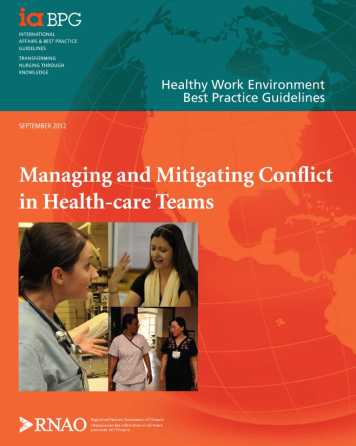
Managing and Mitigating Conflict in Health-care Teams
The purpose of this best practice guideline (BPG) is to manage and mitigate interpersonal conflict among healthcare teams with the view that while some conflict is preventable, healthy conflict can also be beneficial.
All resources
 External link
This article from the Indeed Career Guide page and written by Jennifer Herrity, shares five styles of conflict management and how to select the appropriate conflict management style for the situation. March 26, 2025.
© 2025 Indeed
External linkThis booklet provides suggestions for the employer, supervisor and worker to participate in the reduction of bullying in the workplace. A number of samples and tools are provided including a sample workplace bullying policy and a self-test to determine if you are being bullied.
PSHSA - Public Services Health and Safety Association © 2024
External linkOur approach to conflict is not a fixed part of our character, it is learned behavour that we can change. Dana Caspersen, author of "Changing the Conversation: This video shares the 17 Principles of Conflict Resolution". Offers two simple, transformative actions that we can choose, which can fundamentally change the conflict conversations in our lives.
Reference: Retrieved May 5, 2021 from https://youtu.be/WfQeH3092Sc
External linkThis CNO practice guideline outlines the key factors associated with conflict with clients, colleagues and in the workplace, and offers strategies for preventing and managing conflict that has escalated. It also highlights the role of nurses in formal leadership positions, as well as the importance of the debriefing process in the prevention and management of conflict.
© College of Nurses of Ontario, 2025
External linkConflict is a part of life. Most of us will do almost anything to avoid it. In this video Dr. Jennie Byrne explains a simple healthy nonaggressive step-by-step process for resolving your conflicts or issues with others that can even strengthen your relationships leaving you feeling empowered in your life and in your relationships.
Reference: Retrieved May 5, 2021
 Document
This appendix provides several conflict case scenarios, information about the impact of the conflict, and how conflict can be addressed, managed and/or mitigated.
Registered Nurses’ Association of Ontario. (2012, September). Appendix D of Managing and Mitigating Conflict in Health-care Teams Best Practice Guideline. Toronto, ON, Canada: Author. pp.78-82.
External linkLes lignes directrices sur les pratiques exemplaires portent principalement sur le personnel infirmier, les équipes soignantes et les processus qui favorisent la mise en place de milieux de travail sains. Ces lignes directrices traitent de la gestion et de l’atténuation des conflits interpersonnels au sein des équipes de soins de santé. Elles partent du principe que même s’il est possible d’éviter certains conflits, des conflits sains peuvent également être bénéfiques.
Association des infirmières et infirmiers autorisés de l’Ontario (2012). La gestion et l’atténuation des conflits dans les équipes de soins de santé. Toronto, Canada : Autheur.
Ce travail est financé par le Ministère de la Santé et des Soins de longue durée d'Ontario.
External linkLes lignes directrices sur les pratiques exemplaires portent principalement sur le personnel infirmier, les équipes soignantes et les processus qui favorisent la mise en place de milieux de travail sains. Ces lignes directrices traitent de la gestion et de l’atténuation des conflits interpersonnels au sein des équipes de soins de santé. Elles partent du principe que même s’il est possible d’éviter certains conflits, des conflits sains peuvent également être bénéfiques.
Association des infirmières et infirmiers autorisés de l’Ontario (2012). La gestion et l’atténuation des conflits dans les équipes de soins de santé. Toronto, Canada : Autheur.
Ce travail est financé par le Ministère de la Santé et des Soins de longue durée d'Ontario.
DocumentA tool to assist with comparing your organization’s current practice with evidence-based RNAO best practice recommendations.
Registered Nurses Association of Ontario (2022) Opportunity Analysis- Managing and Mitigating Conflict in Health-care Team. Toronto, ON.
DocumentThis resource outlines organizational recommendations for managing and mitigating conflict in health-care teams.
Registered Nurses’ Association of Ontario. (2012, September). Managing and Mitigating Conflict in Health-care Teams Best Practice Guideline. Toronto, ON, Canada: Author. pp.32-34.
DocumentThese tables provide specific behavioural recommendations to support individuals and teams in managing and mitigating conflict in health-care teams.
Registered Nurses’ Association of Ontario. (2012, September). Managing and Mitigating Conflict in Health-care Teams Best Practice Guideline. Toronto, ON, Canada: Author. pp.39-41.
DocumentThis appendix contains several short tools and approaches to use when promoting respect or responding to disrespectful behavior.
Reference: Registered Nurses’ Association of Ontario (September 2012). Managing and Mitigating Conflict in Health-care Teams Best Practice Guideline. Toronto, ON: RNAO. pp. 83-84.
External linkThis Best Practice Guideline focuses on evidence-based recommendations for RNs and RPNs on best nursing practices for developing and sustaining nursing leadership. This guideline addresses: system resources that support effective leadership practices and behaviours for formal leaders and nurses at the point of care; Organizational culture, values and resources that support effective leadership practices and behaviours at all levels; and personal resources that support effective leadership practices across the continuum of care.
Registered Nurses’ Association of Ontario. (2013). RNAO Developing and sustaining nursing leadership best practice guideline (2nd Ed.). Toronto, ON, Canada: Author.
External linkThis guideline provides evidence-based recommendations for RNs and RPNs on best nursing practices for developing and sustaining effective staffing and workload practices. When effective staffing and workload practices are not followed the risk for conflict within teams increases. Learn how the decision making process must ensure that appropriate structures and supports are in place to maximize the nursing effort resulting in the best possible care and positive outcomes for the patients/clients, nursing personnel, and the organization.
Registered Nurses’ Association of Ontario. (2017). Developing and Sustaining Effective Staffing and Workload Practices. Toronto, ON. Author
External linkThis Best Practice Guideline focuses on nursing teams and processes that foster healthy work environments. The focus for the development of this guideline was managing conflict among nursing and healthcare teams with the view that while some conflict is preventable, healthy conflict can also be beneficial.
Registered Nurses’ Association of Ontario. (2012). Managing and Mitigating Conflict in Health-care Teams. Toronto, ON. Author.
External linkThis Best Practice Guideline focuses on nursing teams and processes that foster healthy work environments. The focus for the development of this guideline was managing conflict among nursing and healthcare teams with the view that while some conflict is preventable, healthy conflict can also be beneficial.
For the purpose of this document, conflict is defined as: a phenomenon occurring between interdependent parties as they experience negative emotional reactions to perceived disagreements and interference with the attainment of their goals (Barki & Hartwick, 2004).
Registered Nurses’ Association of Ontario. (2012). Managing and Mitigating Conflict in Health-care Teams. Toronto, ON:
External linkThis best practice guideline was developed to assist nurses, nursing leaders, other health professionals and senior managers to enhance positive outcomes for patients/clients (individual/family/group/community), nurses, and the organization through intra-professional collaborative practice. The goal of this best practice guideline is to strengthen collaborative practice among nurses, and explore what fosters healthy work environments for them, aware that collaboration must align with the needs of the patient or client
Registered Nurses’ Association of Ontario. (2016). Intra-professional Collaborative Practice among NursesI . Toronto, ON. Author.
External linkThis article by by Jessica Zartler reviews the Five Dysfunctions of a Team Model, and provides a team assessment to determine to what degree the five dysfunctions exist in your team. Sep 7, 2017.
DocumentTips on how to manage and mitigate conflict (e.g. how to be “self-aware” during conflict, five responses to conflict, steps to resolve conflict, questions to ask when conflict arises, barriers to resolution, etc.).
Registered Nurses’ Association of Ontario. (2012, September). Managing and Mitigating Conflict in Health-care Teams Best Practice Guideline. Toronto, ON, Canada: Author. pp. 86-88.
External linkThis guide reviews Lencioni’s 5 dysfunctions of a team model and provides clear tables related to building trust and what people need to feel trusted, mastering conflict, achieving commitment, engaging in conflict resolution, accountability and focusing on results.
Myers-Briggs ® Lencioni Guide
External linkThis fact sheet from the Public Health and Safety Association, describes bullying, how to recognize bullying and tips for preventing workplace bullying. Facts about Workplace Bullying, is downloadable and printable as a resource for team members to learn and understand about Bullying in the workplace.
PSHSA - Public Services Health and Safety Association © 2025
Implementation resources
External linkLes lignes directrices sur les pratiques exemplaires portent principalement sur le personnel infirmier, les équipes soignantes et les processus qui favorisent la mise en place de milieux de travail sains. Ces lignes directrices traitent de la gestion et de l’atténuation des conflits interpersonnels au sein des équipes de soins de santé. Elles partent du principe que même s’il est possible d’éviter certains conflits, des conflits sains peuvent également être bénéfiques.
Association des infirmières et infirmiers autorisés de l’Ontario (2012). La gestion et l’atténuation des conflits dans les équipes de soins de santé. Toronto, Canada : Autheur.
Ce travail est financé par le Ministère de la Santé et des Soins de longue durée d'Ontario.
DocumentThis resource outlines organizational recommendations for managing and mitigating conflict in health-care teams.
Registered Nurses’ Association of Ontario. (2012, September). Managing and Mitigating Conflict in Health-care Teams Best Practice Guideline. Toronto, ON, Canada: Author. pp.32-34.
DocumentThese tables provide specific behavioural recommendations to support individuals and teams in managing and mitigating conflict in health-care teams.
Registered Nurses’ Association of Ontario. (2012, September). Managing and Mitigating Conflict in Health-care Teams Best Practice Guideline. Toronto, ON, Canada: Author. pp.39-41.
DocumentThis appendix contains several short tools and approaches to use when promoting respect or responding to disrespectful behavior.
Reference: Registered Nurses’ Association of Ontario (September 2012). Managing and Mitigating Conflict in Health-care Teams Best Practice Guideline. Toronto, ON: RNAO. pp. 83-84.
External linkThis Best Practice Guideline focuses on nursing teams and processes that foster healthy work environments. The focus for the development of this guideline was managing conflict among nursing and healthcare teams with the view that while some conflict is preventable, healthy conflict can also be beneficial.
For the purpose of this document, conflict is defined as: a phenomenon occurring between interdependent parties as they experience negative emotional reactions to perceived disagreements and interference with the attainment of their goals (Barki & Hartwick, 2004).
Registered Nurses’ Association of Ontario. (2012). Managing and Mitigating Conflict in Health-care Teams. Toronto, ON:
DocumentTips on how to manage and mitigate conflict (e.g. how to be “self-aware” during conflict, five responses to conflict, steps to resolve conflict, questions to ask when conflict arises, barriers to resolution, etc.).
Registered Nurses’ Association of Ontario. (2012, September). Managing and Mitigating Conflict in Health-care Teams Best Practice Guideline. Toronto, ON, Canada: Author. pp. 86-88.
Education resources
External linkThis article from the Indeed Career Guide page and written by Jennifer Herrity, shares five styles of conflict management and how to select the appropriate conflict management style for the situation. March 26, 2025.
© 2025 Indeed
External linkThis booklet provides suggestions for the employer, supervisor and worker to participate in the reduction of bullying in the workplace. A number of samples and tools are provided including a sample workplace bullying policy and a self-test to determine if you are being bullied.
PSHSA - Public Services Health and Safety Association © 2024
External linkOur approach to conflict is not a fixed part of our character, it is learned behavour that we can change. Dana Caspersen, author of "Changing the Conversation: This video shares the 17 Principles of Conflict Resolution". Offers two simple, transformative actions that we can choose, which can fundamentally change the conflict conversations in our lives.
Reference: Retrieved May 5, 2021 from https://youtu.be/WfQeH3092Sc
External linkThis CNO practice guideline outlines the key factors associated with conflict with clients, colleagues and in the workplace, and offers strategies for preventing and managing conflict that has escalated. It also highlights the role of nurses in formal leadership positions, as well as the importance of the debriefing process in the prevention and management of conflict.
© College of Nurses of Ontario, 2025
External linkConflict is a part of life. Most of us will do almost anything to avoid it. In this video Dr. Jennie Byrne explains a simple healthy nonaggressive step-by-step process for resolving your conflicts or issues with others that can even strengthen your relationships leaving you feeling empowered in your life and in your relationships.
Reference: Retrieved May 5, 2021
External linkLes lignes directrices sur les pratiques exemplaires portent principalement sur le personnel infirmier, les équipes soignantes et les processus qui favorisent la mise en place de milieux de travail sains. Ces lignes directrices traitent de la gestion et de l’atténuation des conflits interpersonnels au sein des équipes de soins de santé. Elles partent du principe que même s’il est possible d’éviter certains conflits, des conflits sains peuvent également être bénéfiques.
Association des infirmières et infirmiers autorisés de l’Ontario (2012). La gestion et l’atténuation des conflits dans les équipes de soins de santé. Toronto, Canada : Autheur.
Ce travail est financé par le Ministère de la Santé et des Soins de longue durée d'Ontario.
External linkThis Best Practice Guideline focuses on evidence-based recommendations for RNs and RPNs on best nursing practices for developing and sustaining nursing leadership. This guideline addresses: system resources that support effective leadership practices and behaviours for formal leaders and nurses at the point of care; Organizational culture, values and resources that support effective leadership practices and behaviours at all levels; and personal resources that support effective leadership practices across the continuum of care.
Registered Nurses’ Association of Ontario. (2013). RNAO Developing and sustaining nursing leadership best practice guideline (2nd Ed.). Toronto, ON, Canada: Author.
External linkThis guideline provides evidence-based recommendations for RNs and RPNs on best nursing practices for developing and sustaining effective staffing and workload practices. When effective staffing and workload practices are not followed the risk for conflict within teams increases. Learn how the decision making process must ensure that appropriate structures and supports are in place to maximize the nursing effort resulting in the best possible care and positive outcomes for the patients/clients, nursing personnel, and the organization.
Registered Nurses’ Association of Ontario. (2017). Developing and Sustaining Effective Staffing and Workload Practices. Toronto, ON. Author
External linkThis Best Practice Guideline focuses on nursing teams and processes that foster healthy work environments. The focus for the development of this guideline was managing conflict among nursing and healthcare teams with the view that while some conflict is preventable, healthy conflict can also be beneficial.
Registered Nurses’ Association of Ontario. (2012). Managing and Mitigating Conflict in Health-care Teams. Toronto, ON. Author.
External linkThis best practice guideline was developed to assist nurses, nursing leaders, other health professionals and senior managers to enhance positive outcomes for patients/clients (individual/family/group/community), nurses, and the organization through intra-professional collaborative practice. The goal of this best practice guideline is to strengthen collaborative practice among nurses, and explore what fosters healthy work environments for them, aware that collaboration must align with the needs of the patient or client
Registered Nurses’ Association of Ontario. (2016). Intra-professional Collaborative Practice among NursesI . Toronto, ON. Author.
External linkThis article by by Jessica Zartler reviews the Five Dysfunctions of a Team Model, and provides a team assessment to determine to what degree the five dysfunctions exist in your team. Sep 7, 2017.
External linkThis guide reviews Lencioni’s 5 dysfunctions of a team model and provides clear tables related to building trust and what people need to feel trusted, mastering conflict, achieving commitment, engaging in conflict resolution, accountability and focusing on results.
Myers-Briggs ® Lencioni Guide
External linkThis fact sheet from the Public Health and Safety Association, describes bullying, how to recognize bullying and tips for preventing workplace bullying. Facts about Workplace Bullying, is downloadable and printable as a resource for team members to learn and understand about Bullying in the workplace.
PSHSA - Public Services Health and Safety Association © 2025
Evaluation resources
There are no evaluation resources available for this topic.
BPG appendices
DocumentThis appendix provides several conflict case scenarios, information about the impact of the conflict, and how conflict can be addressed, managed and/or mitigated.
Registered Nurses’ Association of Ontario. (2012, September). Appendix D of Managing and Mitigating Conflict in Health-care Teams Best Practice Guideline. Toronto, ON, Canada: Author. pp.78-82.
