RNAO coaches can help

Through collaborations with LTC homes, our team of coaches work towards improving resident care and promoting positive workplaces by implementing RNAO’s clinical and healthy work environment best practice guidelines.

Contact a coach

Identify where you can improve

Use RNAO's gap (opportunity) analysis tool to help identify where evidence-based best practice recommendations can improve your organization's current practice.

Skin and wound care

Supports LTC teams in preventing and managing pressure injuries and wounds. Includes assessment tools, care planning resources, education materials, and guidelines based on best practices.

All resources

External link
On April 11, 2023, changes to Ontario Regulation 246/22 (the "Regulation") under the Fixing Long-Term Care Act, 2021 (the "Act") came into effect. Informed by engagement with key partners and stakeholders, as well as feedback from the public, the Ministry of Long-Term Care (the "Ministry") has refined the regulatory framework with consideration of the lived experience of residents and long-term care homes and emerging needs in the sector. © King’s Printer for Ontario, 2012-24  
Document
The resource list includes standardized terms used when referring to support surfaces. The National Pressure Injury Advisory Panel, (NPIAP) developed these terms and definitions to allow for standard, and clear language when describing support surfaces.  Source: National Pressure Injury Advisory Panel (NIPAP). Support surfaces standards initiative (S31): Terms and definitions related to support surfaces. NIPAP; 2019. Reference: Registered Nurses’ Association of Ontario, (2024). Appendix O of Pressure injury management: Risk assessment, prevention and treatment - Fourth edition. Toronto, Canada: Author. pp. 113-114.
External link
Bates-Jenson Wound Assessment Tool (BWAT) is a validated tool that measures the status of a wound. It is most appropriate for use by experienced wound-care clinicians as a discriminative tool to fully describe wounds during the initial wound assessment.  Reference: Bates-Jensen, Barbara (2001). Bates-Jenson Wound Assessment Tool (BWAT). Copyright 2001 Barbara Bates-Jensen
External link
The Braden Scale can be used to assess a resident’s level of risk for developing pressure injuries by evaluating six areas of risk: sensory perception, moisture, activity, mobility, nutrition, and friction or shear. © Copyright Barbara Braden and Nancy Bergstrom, 1988  
External link
This open textbook chapter discusses the types of ostomies and ostomy appliances, reviews physical and emotional assessments, provides checklists with steps for changing ostomy and urostomy appliances, with photographs, and discusses safety considerations. Included is a video on evidence-based research on ostomy care and a video on illiostomy and urostomy care. If you are an instructor who is using this book for a course, please let us know. For more information about this project, please contact [email protected]. Disclaimer The field of health care is constantly changing and evolving. Procedures and policies in schools and health care agencies will change in accordance with research and practice. This resource will require updates to remain in accordance with these changes, but the authors do not assume responsibility for these updates. Health care professionals must ensure that they have a strong foundation of knowledge in medical conditions and surgical procedures related to clinical skills and techniques before using this resource to guide their practice. Health care professionals should always put agency policy above the information in this resource and be mindful of their own safety and the safety of others. Any health care professional using this resource should do so in the appropriate environment and under the supervision of other relevant health care professionals, in accordance with their governing professional body and within their scope of practice. It is the responsibility of any health care professionals using this book to take all appropriate safety precautions and to determine best practice unique to the patient and the context of the situation. The authors do not assume responsibility for any injury or damage to persons or property pertaining to the use of the material and information in this resource.
External link
This resource compares different types of chronic wounds to assist health providers in differentiating wounds they may see in clinical practice. Source: National Pressure Injury Advisory Panel (NIPAP). Support surfaces standards initiative (S31): Terms and definitions related to support surfaces. NIPAP; 2019. Reference: Registered Nurses’ Association of Ontario, (2024). Appendix P of Pressure injury management: Risk assessment, prevention and treatment - Fourth edition. Toronto, Canada: Author. pp. 115-116.
Document
This resource compares different types of chronic wounds to assist health providers in differentiating wounds they may see in clinical practice. Source: National Pressure Injury Advisory Panel (NIPAP). Support surfaces standards initiative (S31): Terms and definitions related to support surfaces. NIPAP; 2019. Reference: Registered Nurses’ Association of Ontario, (2024). Appendix P of Pressure injury management: Risk assessment, prevention and treatment - Fourth edition. Toronto, Canada: Author. pp. 115-116.
External link
Connecting Learning With Knowledge (CLWK) was created by nurses to explore innovative ways to meet nurses’ education needs. This page takes you to a library of educational resources for skin health and pressure injury prevention, wound and ostomy resources and interactive learning modules and videos. Copyright © 2021 CLWK: Connecting Learners with Knowledge. All Rights Reserved.  
External link
The Leading Change Toolkit includes two frameworks- the Social Movement Action (SMA) Framework and the Knowledge-to-Action (KTA) Framework. Both frameworks outline the concept of implementation and its interrelated components. The toolkit is based on available evidence, theoretical perspectives and consensus. We recommend the Leading Change Toolkit for guiding the implementation of any BPG in health care or social service organizations, including academic centres Reference: Registered Nurses’ Association of Ontario, (2024). Appendix M of Diabetic foot ulcers: Prevention, assessment and management, Third edition. Toronto, Canada: Author. pp. 126-127.  
Document
The Leading Change Toolkit includes two frameworks- the Social Movement Action (SMA) Framework and the Knowledge-to-Action (KTA) Framework. Both frameworks outline the concept of implementation and its interrelated components. The toolkit is based on available evidence, theoretical perspectives and consensus. We recommend the Leading Change Toolkit for guiding the implementation of any BPG in health care or social service organizations, including academic centres Reference: Registered Nurses’ Association of Ontario, (2024). Appendix M of Diabetic foot ulcers: Prevention, assessment and management, Third edition. Toronto, Canada: Author. pp. 126-127.  
External link
The Leading Change Toolkit includes two frameworks- the Social Movement Action (SMA) Framework and the Knowledge-to-Action (KTA) Framework. Both frameworks outline the concept of implementation and its interrelated components. The toolkit is based on available evidence, theoretical perspectives and consensus. We recommend the Leading Change Toolkit for guiding the implementation of any BPG in health care or social service organizations, including academic centres. Reference: Registered Nurses’ Association of Ontario, (2024). Appendix R of Pressure injury management: Risk assessment, prevention and treatment - Fourth edition. Toronto, Canada: Author. pp. 118-119.
Document
The Leading Change Toolkit includes two frameworks- the Social Movement Action (SMA) Framework and the Knowledge-to-Action (KTA) Framework. Both frameworks outline the concept of implementation and its interrelated components. The toolkit is based on available evidence, theoretical perspectives and consensus. We recommend the Leading Change Toolkit for guiding the implementation of any BPG in health care or social service organizations, including academic centres. Reference: Registered Nurses’ Association of Ontario, (2024). Appendix R of Pressure injury management: Risk assessment, prevention and treatment - Fourth edition. Toronto, Canada: Author. pp. 118-119.
External link
"DFU-VIPS" (diabetic foot ulcer- vascular supply, infection, pressure and sharp debridement and social determinants of health), is an acronym that assists as a memory aid for items to assess when providing care to a person at risk of or living with a diabetic foot ulcer.  Reference: Registered Nurses’ Association of Ontario, (2024). Appendix J of Diabetic foot ulcers: Prevention, assessment and management, Third edition. Toronto, Canada: Author. pp. 117.
Document
"DFU-VIPS" (diabetic foot ulcer- vascular supply, infection, pressure and sharp debridement and social determinants of health), is an acronym that assists as a memory aid for items to assess when providing care to a person at risk of or living with a diabetic foot ulcer.  Reference: Registered Nurses’ Association of Ontario, (2024). Appendix J of Diabetic foot ulcers: Prevention, assessment and management, Third edition. Toronto, Canada: Author. pp. 117.
External link
This risk assessment triage referral form is an example form for primary health providers to utilize when requesting referrals to a specialized wound care team. Reference: Registered Nurses’ Association of Ontario, (2024). Appendix G of Diabetic foot ulcers: Prevention, assessment and management, Third edition. Toronto, Canada: Author. pp. 113.
Document
This risk assessment triage referral form is an example form for primary health providers to utilize when requesting referrals to a specialized wound care team. Reference: Registered Nurses’ Association of Ontario, (2024). Appendix G of Diabetic foot ulcers: Prevention, assessment and management, Third edition. Toronto, Canada: Author. pp. 113.
Document
A tool to assist with comparing your organization’s current practice with evidence-based RNAO best practice recommendations. Registered Nurses’ Association of Ontario (2024). Opportunity Analysis Diabetic foot ulcers: Prevention, assessment and management, Third edition. Toronto, ON.
External link
This table provides an outline of the distinguishing features of incontinence-associated dermatitis and pressure injuries. It may help health providers differentiate between the two types of wounds. Reference: Registered Nurses’ Association of Ontario, (2024). Appendix Q of Pressure injury management: Risk assessment, prevention and treatment - Fourth edition. Toronto, Canada: Author. pp.117. Source: Reprinted with permission from: Beeckman D et al. Proceedings of the Global IAD Expert Panel. Incontinence associated dermatitis: moving prevention forward. Wounds International 2015.
Document
This table provides an outline of the distinguishing features of incontinence-associated dermatitis and pressure injuries. It may help health providers differentiate between the two types of wounds. Reference: Registered Nurses’ Association of Ontario, (2024). Appendix Q of Pressure injury management: Risk assessment, prevention and treatment - Fourth edition. Toronto, Canada: Author. pp.117. Source: Reprinted with permission from: Beeckman D et al. Proceedings of the Global IAD Expert Panel. Incontinence associated dermatitis: moving prevention forward. Wounds International 2015.
External link
RNAO clinical BPGs included education recommendations directed to those responsible for the academic and in-service education of nursing students, nurses and the interprofessional team. These recommendations outlined core content and training strategies required for entry-level health programs, continued education and professional development. Reference: Registered Nurses’ Association of Ontario, (2024). Appendix D of Pressure injury management: Risk assessment, prevention and treatment - Fourth edition. Toronto, Canada: Author. pp. 92-96.
Document
RNAO clinical BPGs included education recommendations directed to those responsible for the academic and in-service education of nursing students, nurses and the interprofessional team. These recommendations outlined core content and training strategies required for entry-level health programs, continued education and professional development. Reference: Registered Nurses’ Association of Ontario, (2024). Appendix D of Pressure injury management: Risk assessment, prevention and treatment - Fourth edition. Toronto, Canada: Author. pp. 92-96.
External link
RNAO clinical BPGs included education recommendations directed to those responsible for the academic and in-service education of nursing students, nurses and the interprofessional team. These recommendations outlined core content and training strategies required for entry-level health programs, continued education and professional development. Reference: Registered Nurses’ Association of Ontario, (2024). Appendix L of Diabetic foot ulcers: Prevention, assessment and management, Third edition. Toronto, Canada: Author. pp. 121-125.    
Document
RNAO clinical BPGs included education recommendations directed to those responsible for the academic and in-service education of nursing students, nurses and the interprofessional team. These recommendations outlined core content and training strategies required for entry-level health programs, continued education and professional development. Reference: Registered Nurses’ Association of Ontario, (2024). Appendix L of Diabetic foot ulcers: Prevention, assessment and management, Third edition. Toronto, Canada: Author. pp. 121-125.    
External link
Emerging health technologies for assessment and detection, outlines additional or emerging health technologies which may be available for the assessment and early detection of pressure injuries. It does not represent an exhaustive list.   Reference: Registered Nurses’ Association of Ontario, (2024). Appendix L of Pressure injury management: Risk assessment, prevention and treatment - Fourth edition. Toronto, Canada: Author. pp. 108-109.  
Document
Emerging health technologies for assessment and detection, outlines additional or emerging health technologies which may be available for the assessment and early detection of pressure injuries. It does not represent an exhaustive list.   Reference: Registered Nurses’ Association of Ontario, (2024). Appendix L of Pressure injury management: Risk assessment, prevention and treatment - Fourth edition. Toronto, Canada: Author. pp. 108-109.  
External link
This resource from the Nation Pressure Injury Advisory Panel (NPIAP), is an example of a validated classification system used to classify pressure injuries. Reference: Registered Nurses’ Association of Ontario, (2024). Appendix H of Pressure injury management: Risk assessment, prevention and treatment - Fourth edition. Toronto, Canada: Author. pp. 102. Source: © National Pressure Injury Advisory Panel September 2016.  
Document
This resource from the Nation Pressure Injury Advisory Panel (NPIAP), is an example of a validated classification system used to classify pressure injuries. Reference: Registered Nurses’ Association of Ontario, (2024). Appendix H of Pressure injury management: Risk assessment, prevention and treatment - Fourth edition. Toronto, Canada: Author. pp. 102. Source: © National Pressure Injury Advisory Panel September 2016.  
External link
This resource from the Canadian Nutrition Society, is an example of a nutrition screening tool which can be used to identify those who may be at risk for malnutrition. Reference: Registered Nurses’ Association of Ontario, (2024). Appendix J of Pressure injury management: Risk assessment, prevention and treatment - Fourth edition. Toronto, Canada: Author. pp. 104-105.  
Document
This resource from the Canadian Nutrition Society, is an example of a nutrition screening tool which can be used to identify those who may be at risk for malnutrition. Reference: Registered Nurses’ Association of Ontario, (2024). Appendix J of Pressure injury management: Risk assessment, prevention and treatment - Fourth edition. Toronto, Canada: Author. pp. 104-105.  
External link
Appendix F is an example of a preventative care bundle which may be used to educate residents, family and caregivers. It features the SSKIN bundle (Skin inspection, Surface, Keep moving, Incontinence & moisture and Nutrition). Reference: Registered Nurses’ Association of Ontario, (2024). Appendix F of Pressure injury management: Risk assessment, prevention and treatment - Fourth edition. Toronto, Canada: Author. pp. 99. Source: Reprinted with permission from: Wounds Canada. Pressure injury prevention: SSKIN bundle [Internet]. North York (ON): Wounds Canada; [date unknown]. 
Document
Appendix F is an example of a preventative care bundle which may be used to educate residents, family and caregivers. It features the SSKIN bundle (Skin inspection, Surface, Keep moving, Incontinence & moisture and Nutrition). Reference: Registered Nurses’ Association of Ontario, (2024). Appendix F of Pressure injury management: Risk assessment, prevention and treatment - Fourth edition. Toronto, Canada: Author. pp. 99. Source: Reprinted with permission from: Wounds Canada. Pressure injury prevention: SSKIN bundle [Internet]. North York (ON): Wounds Canada; [date unknown]. 
External link
This resource illustrates two examples of wound care frameworks: the wound bed preparation paradigm, reprinted with permission from Sibbald RG, Elliott JA, Persaud-Jaimangal R, et al. Wound Bed Preparation 2021. Adv Skin Wound Care. 2021 Apr 1;34(4):183–95. And, the wound prevention and management cycle, reprinted with permission from Orsted HL, Keast DH, Forest-Lalande L, et al. Best practice recommendations for the prevention and management of wounds. In: Foundations of Best Practice for Skin and Wound Management. A supplement of Wound Care Canada; 2017. 74 pp.  Reference: Registered Nurses’ Association of Ontario, (2024). Appendix D of Pressure injury management: Risk assessment, prevention and treatment - Fourth edition. Toronto, Canada: Author. pp. 97-98.
Document
This resource illustrates two examples of wound care frameworks: the wound bed preparation paradigm, reprinted with permission from Sibbald RG, Elliott JA, Persaud-Jaimangal R, et al. Wound Bed Preparation 2021. Adv Skin Wound Care. 2021 Apr 1;34(4):183–95. And, the wound prevention and management cycle, reprinted with permission from Orsted HL, Keast DH, Forest-Lalande L, et al. Best practice recommendations for the prevention and management of wounds. In: Foundations of Best Practice for Skin and Wound Management. A supplement of Wound Care Canada; 2017. 74 pp.  Reference: Registered Nurses’ Association of Ontario, (2024). Appendix D of Pressure injury management: Risk assessment, prevention and treatment - Fourth edition. Toronto, Canada: Author. pp. 97-98.
External link
These validated assessment tools will assist health providers in conducting a comprehensive assessment of a diabetic foot ulcer and provide a baseline for the diabetic foot ulcer. Examples of diabetic foot classification tools and wound progression tools are provided. Reference: Registered Nurses’ Association of Ontario, (2024). Appendix H of Diabetic foot ulcers: Prevention, assessment and management, Third edition. Toronto, Canada: Author. pp. 114.
Document
These validated assessment tools will assist health providers in conducting a comprehensive assessment of a diabetic foot ulcer and provide a baseline for the diabetic foot ulcer. Examples of diabetic foot classification tools and wound progression tools are provided. Reference: Registered Nurses’ Association of Ontario, (2024). Appendix H of Diabetic foot ulcers: Prevention, assessment and management, Third edition. Toronto, Canada: Author. pp. 114.
External link
Having an ostomy procedure is a life changing experience for you and your family. Learning how to take care of your ostomy will help you to gain independence and live your life with comfort and confidence. Registered Nurses’ Association of Ontario. (2020). 
External link
A glossary of terms used throughout the best practice guideline: Diabetic foot ulcers: Prevention, assessment and management.  Reference: Registered Nurses’ Association of Ontario, (2024). Appendix A of Diabetic foot ulcers: Prevention, assessment and management, Third edition. Toronto, Canada: Author. pp. 86-95.    
Document
A glossary of terms used throughout the best practice guideline: Diabetic foot ulcers: Prevention, assessment and management.  Reference: Registered Nurses’ Association of Ontario, (2024). Appendix A of Diabetic foot ulcers: Prevention, assessment and management, Third edition. Toronto, Canada: Author. pp. 86-95.    
External link
This resource is a glossary of terms used throughout the best practice guideline, Pressure injury management: Risk assessment, prevention and treatment - Fourth edition pp. 81-87. Registered Nurses’ Association of Ontario. (2024). Pressure injury management: Risk assessment, prevention and treatment, Fourth Edition. Toronto, ON
Document
This resource is a glossary of terms used throughout the best practice guideline, Pressure injury management: Risk assessment, prevention and treatment - Fourth edition pp. 81-87. Registered Nurses’ Association of Ontario. (2024). Pressure injury management: Risk assessment, prevention and treatment, Fourth Edition. Toronto, ON
Document
A glossary of terms used throughout the best practice guideline.  Appendix A of Pressure injury management: Risk assessment, prevention and treatment, Fourth edition. Toronto, Canada: Author. pp. 81-87. Registered Nurses’ Association of Ontario. (2024). Pressure injury management: Risk assessment, prevention and treatment, Fourth Edition. Toronto, ON: Author.  
External link
A two-page summary of the European Wound Management Association (EWMA) guidance on holistic management of wound-related pain. It includes a decision-aid to guide holistic management of wound-related pain. Source: Reprinted with permission from: The European Wound Management Association. Holistic management of wound-related pain. J Wound Management. 2024; 24 (1 Sup 1).  Reference: Registered Nurses’ Association of Ontario, (2024). Appendix K of Pressure injury management: Risk assessment, prevention and treatment - Fourth edition. Toronto, Canada: Author. pp 106-107.    
Document
A two-page summary of the European Wound Management Association (EWMA) guidance on holistic management of wound-related pain. It includes a decision-aid to guide holistic management of wound-related pain. Source: Reprinted with permission from: The European Wound Management Association. Holistic management of wound-related pain. J Wound Management. 2024; 24 (1 Sup 1).  Reference: Registered Nurses’ Association of Ontario, (2024). Appendix K of Pressure injury management: Risk assessment, prevention and treatment - Fourth edition. Toronto, Canada: Author. pp 106-107.    
External link
Hollister Education has developed an online course in Ostomy Care that offers healthcare professionals the opportunity to learn more about this specialized area of care. There are a total of five lessons that may be viewed in any order, with an assessment at the conclusion of each lesson. Each lesson contains a glossary of terms and reference resources. Topics include: Lesson 1: Ostomy overview Lesson 2: Pouching systems Lesson 3: Ostomy accessories Lesson 4: Problem solving Lesson 5: Education and resources © 2025 Hollister Incorporated
External link
This table compares different types of chronic wounds to assist health providers in differentiating wounds they may see in clinical practice. Reference: Registered Nurses’ Association of Ontario, (2024). Appendix I of Diabetic foot ulcers: Prevention, assessment and management, Third edition. Toronto, Canada: Author. pp. 115-116 .
Document
This table compares different types of chronic wounds to assist health providers in differentiating wounds they may see in clinical practice. Reference: Registered Nurses’ Association of Ontario, (2024). Appendix I of Diabetic foot ulcers: Prevention, assessment and management, Third edition. Toronto, Canada: Author. pp. 115-116 .
External link
This screening guide provides a systematic method that can be used by health providers for foot ulcer prevention and ongoing screening after an ulcer or complication occurs.  Reference: Registered Nurses’ Association of Ontario, (2024). Appendix D of Diabetic foot ulcers: Prevention, assessment and management, Third edition. Toronto, Canada: Author pp. 104-105.
Document
This screening guide provides a systematic method that can be used by health providers for foot ulcer prevention and ongoing screening after an ulcer or complication occurs.  Reference: Registered Nurses’ Association of Ontario, (2024). Appendix D of Diabetic foot ulcers: Prevention, assessment and management, Third edition. Toronto, Canada: Author pp. 104-105.
External link
The IWGDF risk stratification system allows health providers to establish foot screening and examination frequency based on resulting risk categories. Reference: Registered Nurses’ Association of Ontario, (2024). Appendix E of Diabetic foot ulcers: Prevention, assessment and management, Third edition. Toronto, Canada: Author. pp. 106.  
Document
The IWGDF risk stratification system allows health providers to establish foot screening and examination frequency based on resulting risk categories. Reference: Registered Nurses’ Association of Ontario, (2024). Appendix E of Diabetic foot ulcers: Prevention, assessment and management, Third edition. Toronto, Canada: Author. pp. 106.  
External link
A list of acronyms used throughout the guideline Pressure injury management: Risk assessment, prevention and treatment - Fourth edition. pp. 81-89. Reference: Registered Nurses’ Association of Ontario, (2024).
Document
A list of acronyms used throughout the guideline Pressure injury management: Risk assessment, prevention and treatment - Fourth edition. pp. 81-89. Reference: Registered Nurses’ Association of Ontario, (2024).
External link
This information fact sheet is developed as a supplement to the RNAO Nursing Best Practice Guideline document for nurses. The Fact Sheet reviews foot ulcer in relation to people with diabetes. Foot ulcers increase the risk of infection (a germ or bacteria that invades and damages the tissues) and may reduce your quality of life. While most foot ulcers heal, when they are left untreated, they could lead to foot amputations.   
External link
The National Pressure Injury Advisory Panel (NPIAP) serves as the authoritative voice for improved patient outcomes in pressure ulcer prevention and treatment through public policy, education and research.  
External link
A pain rating scale used to determine a persons level of pain. Scored 0-10 with the anchors of 0 being ‘no pain’ and 10 being ‘pain as bad as it can be’ Used in adults, older adults, and adolescents and children over age 8. Well established evidence of reliability, validity, and ability to detect change No equipment is needed to administer this measure High feasibility (quick and easy to use) Reference: McCaffery, M., Beebe, A., et al. (1989). Pain: Clinical manual for nursing practice, Mosby St. Louis, MO
External link
This fact sheet outlines factors to consider regarding offloading pressures, recommendations for offloading devices for forefoot ulcers and offloading device choices (with advantages and disadvantages). Reference: Registered Nurses’ Association of Ontario, (2024). Appendix K of Diabetic foot ulcers: Prevention, assessment and management, Third edition. Toronto, Canada: Author. pp. 118-120.  
Document
This fact sheet outlines factors to consider regarding offloading pressures, recommendations for offloading devices for forefoot ulcers and offloading device choices (with advantages and disadvantages). Reference: Registered Nurses’ Association of Ontario, (2024). Appendix K of Diabetic foot ulcers: Prevention, assessment and management, Third edition. Toronto, Canada: Author. pp. 118-120.  
External link
Ontario Regulation 246/22 was made under The Fixing Long-Term Care Act, 2021 (FLTCA) was proclaimed into force to regulate Ontario's long-term care home sector April 11, 2022. © King’s Printer for Ontario, 2012-24
External link
This link to the RNAO Woundcare Interest Group (OntWIG) website leads to resources and information regarding the benefits of membership and the role of interest group members in leading, promoting and influencing wound related public policy in Ontario.   © RNAO  
External link
This resource from Interior Health, is a pain assessment tool useful for scoring pain levels of people with dementia who are unable to verbally express their pain. It focuses on assessing behaviours and provides a score rating of mild, moderate or severe pain levels. Warden, V., Hurley, A. & Volicer. L. (2003). Development and psychometric evaluation of the pain assessment in advanced dementia (PAINAD) scale. JAMDA, 4(1), 9 -15. Horgas, A., & Miller, L. (2008). Pain assessment in people with dementia. American Journal of Nursing, 108(7), 62-70.  
External link
Pan Pacific Pressure Injury Alliance outlines some considerations for risk assessment and treatment of pressure injuries in people with dark skin tones. Additionally, it includes classification based on the NPIAP/EUPAP classification system with examples of each stage in people with dark skin tones. Registered Nurses’ Association of Ontario, (2024). Appendix I of Pressure injury management: Risk assessment, prevention and treatment - Fourth edition. Toronto, Canada: Author. pp. 103. Source: Reprinted with permission from: Pan Pacific Pressure Injury Alliance (PPPIA). Pressure ulcers in people with dark skin tones: PPPIA; 2014.       
Document
Pan Pacific Pressure Injury Alliance outlines some considerations for risk assessment and treatment of pressure injuries in people with dark skin tones. Additionally, it includes classification based on the NPIAP/EUPAP classification system with examples of each stage in people with dark skin tones. Registered Nurses’ Association of Ontario, (2024). Appendix I of Pressure injury management: Risk assessment, prevention and treatment - Fourth edition. Toronto, Canada: Author. pp. 103. Source: Reprinted with permission from: Pan Pacific Pressure Injury Alliance (PPPIA). Pressure ulcers in people with dark skin tones: PPPIA; 2014.       
External link
This list of pressure injury assessment tools is not exhaustive. These tools have been suggested as examples and were identified through the systematic review or by the expert panel. The most common, valid, and reliable wound assessment tools for use in adults are the following (not in order of importance): Pressure Ulcer Scale for Healing (PUSH); Photographic Wound Assessment Tool (PWAT) and Bates-Jensen Wound Assessment Tool (BWAT). For a detailed, systematic analysis of all available assessment tools see the systematic review by Smet et al, 2021 (134). Reference: Registered Nurses’ Association of Ontario, (2024). Appendix M of Pressure injury management: Risk assessment, prevention and treatment - Fourth edition. Toronto, Canada: Author. pp.110.
Document
This list of pressure injury assessment tools is not exhaustive. These tools have been suggested as examples and were identified through the systematic review or by the expert panel. The most common, valid, and reliable wound assessment tools for use in adults are the following (not in order of importance): Pressure Ulcer Scale for Healing (PUSH); Photographic Wound Assessment Tool (PWAT) and Bates-Jensen Wound Assessment Tool (BWAT). For a detailed, systematic analysis of all available assessment tools see the systematic review by Smet et al, 2021 (134). Reference: Registered Nurses’ Association of Ontario, (2024). Appendix M of Pressure injury management: Risk assessment, prevention and treatment - Fourth edition. Toronto, Canada: Author. pp.110.
Document
A tool to assist with comparing your organization’s current practice with evidence-based RNAO best practice recommendations. Registered Nurses’ Association of Ontario. (2024). Opportunity Analysis-Pressure injury management: Risk assessment, prevention and treatment, Fourth Edition. Toronto, ON.   
External link
This webpage provides links to illustrations for each of the new pressure injury stages. Copyright: These illustrations can be downloaded by clicking on the links below directly to your computer at no cost, if for educational purposes. There is no cost to use these illustrations; however donations to support the work of NPUAP are graciously accepted. For profit uses of the drawings are subject to a charge, please contact Jen Bank for more information. **Use of drawings is permitted for educational purposes only.  
External link
Pressure Ulcer Scale for Healing (PUSH) Tool 3.0 was developed by the National Pressure Ulcer Advisory Panel (NPUAP) as a valid and reliable tool to assess the change in status of pressure ulcers over time. The link takes you to the NPUAP website where you will find the tools and information on use and copyright. PUSH Tool (web version) PUSH Tool (PDF version) Reprint Agreement (PDF) Information and Registration Form Instructions for Using PUSH Copyright Policy and Contract Reference: National Pressure Ulcer Advisory Committee (1998).
External link
This table developed through the Residents First Initiative provides examples of clinical and organizational change strategy options in the area of pressure ulcers. Health Quality Ontario. (2011, February). Pressure Ulcers – Clinical and Organizational Change Concepts and Ideas.  
External link
This poster outlines key steps in the development of a pressure ulcer Quality Improvement plan. The poster is intended for use as a worksheet that can support the needs of individual organizations. Reference: Health Quality Ontario, (2011), Pressure Ulcer Change Poster.  
External link
The Wounds Canada, Professional Guide is focused on caring for a person with an ostomy in the community setting. It addresses psychosocial and lifestyle issues, recognition of possible complications, discussion of interventions and identification of resources available to health-care providers and patients and their families. © 2023 Wounds Canada · All rights reserved.      
External link
Examples of 4 pressure injury risk assessment tools, however this list is not an exhaustive. These tools were identified, by the expert panel and external reviewers or through the systematic review process. The most common, valid, and reliable wound assessment tools for use in adults are the following (not in order of importance): Braden scale; Norton scale; interRAI Pressure Ulcer Risk Scale (PURS) and the Waterlow scale. Source: Table adapted from Prevention and Treatment of Pressure Ulcers/Injuries: Clinical Practice Guideline. The International Guideline 2019. interRAI PURS Pressure Ulcer Risk Scale (PURS) from Canadian Institute for Health Information. interRAI Home Care (HC) Outcome Scales [job aid]. Ottawa, ON: CIHI; 2024 Reference: Registered Nurses’ Association of Ontario, (2024). Pressure injury management: Risk assessment, prevention and treatment - Fourth edition. Toronto, Canada: Author. pp. 100-101.
Document
Examples of 4 pressure injury risk assessment tools, however this list is not an exhaustive. These tools were identified, by the expert panel and external reviewers or through the systematic review process. The most common, valid, and reliable wound assessment tools for use in adults are the following (not in order of importance): Braden scale; Norton scale; interRAI Pressure Ulcer Risk Scale (PURS) and the Waterlow scale. Source: Table adapted from Prevention and Treatment of Pressure Ulcers/Injuries: Clinical Practice Guideline. The International Guideline 2019. interRAI PURS Pressure Ulcer Risk Scale (PURS) from Canadian Institute for Health Information. interRAI Home Care (HC) Outcome Scales [job aid]. Ottawa, ON: CIHI; 2024 Reference: Registered Nurses’ Association of Ontario, (2024). Pressure injury management: Risk assessment, prevention and treatment - Fourth edition. Toronto, Canada: Author. pp. 100-101.
External link
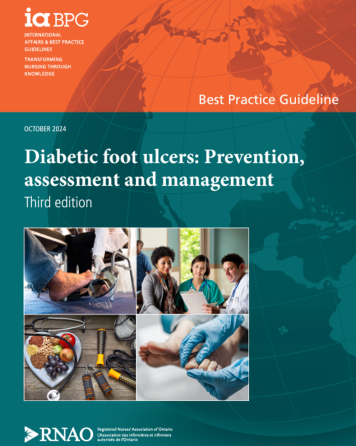
This BPG replaces two RNAO BPGs: Reducing Foot Complications for People with Diabetes (7) published in 2007 and Assessment and Management of Foot Ulcers for People with Diabetes (8) published in 2013. These BPGs were merged because of the overlapping clinical concepts in each BPG. The purpose of this third edition guideline is to provide nurses and members of the interprofessional team, persons at risk of or living with a Diabetic Foot Ulcers (DFU) and their care partners with evidence-based recommendations on the prevention, assessment and management of DFUs. Registered Nurses’ Association of Ontario (2024). RNAO Diabetic foot ulcers: Prevention, assessment and management, Third edition. Toronto, ON: Author.  This work is funded by the Ontario Ministry of Health and Long-Term Care.
External link
A tool to assist with comparing your organization’s current practice with evidence-based RNAO best practice recommendations. Registered Nurses’ Association of Ontario (2024). RNAO Diabetic foot ulcers: Prevention, assessment and management, Third edition. Toronto, ON: Author
External link
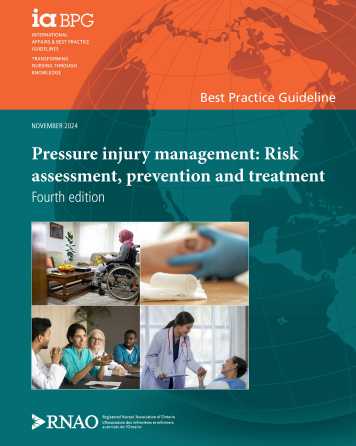
The purpose of this guideline is to provide nurses, members of the interprofessional team and other collaborators (i.e., administrators and policy-makers) with evidence-based recommendations for risk assessment, prevention, and treatment of pressure injuries .  This BPG provides evidence-based recommendations for nurses, and the interprofessional team, and persons and their caregivers across all care settings and sectors. The recommendations address the prevention of pressure injuries for at-risk people, and the assessment and management of those living with pressure injuries. Overall, the scope includes: all domains of nursing practice; all health-care settings and sectors; all populations across the lifespan (e.g., pediatric, adult and older adult), including their caregiver/chosen family and all types of pressure injuries, including those medical device-related. Registered Nurses’ Association of Ontario. (2024).   Pressure injury management: Risk assessment, prevention and treatment, Fourth Edition. Toronto, ON: Author. 
External link
This appendix is a list of RNAO guidelines and resources from other organizations that align with Pressure injury management: Risk assessment, prevention and treatment, Fourth edition. Author. pp. 90-91. Registered Nurses’ Association of Ontario. (2024). Pressure injury management: Risk assessment, prevention and treatment, Fourth Edition. Toronto, ON
Document
This appendix is a list of RNAO guidelines and resources from other organizations that align with Pressure injury management: Risk assessment, prevention and treatment, Fourth edition. Author. pp. 90-91. Registered Nurses’ Association of Ontario. (2024). Pressure injury management: Risk assessment, prevention and treatment, Fourth Edition. Toronto, ON
External link
Appendix B is a list of topics and resources that align with the best practice guideline: Diabetic foot ulcers: Prevention, assessment and management. Reference: Registered Nurses’ Association of Ontario, (2024). Appendix b of Diabetic foot ulcers: Prevention, assessment and management, Third edition. Toronto, Canada: Author pp. 96.    
Document
Appendix B is a list of topics and resources that align with the best practice guideline: Diabetic foot ulcers: Prevention, assessment and management. Reference: Registered Nurses’ Association of Ontario, (2024). Appendix b of Diabetic foot ulcers: Prevention, assessment and management, Third edition. Toronto, Canada: Author pp. 96.    
Document
SBORS Observation Reporting Tool for Skin and Wound Care can be used by personal support workers (PSW) to document the: situation, background, observation and recommendation/suggestion.   Adapted from Waterloo Wellington HPC Consultation Services (2017). SBORS. Palliative Care Canada ECHO Project. (2022) SBORS. Personal Support Worker Community of Practice Series. Barbara Braden and Nancy Bergstrom. (1988) Braden Scale  
External link
This self-screening tool provides a systematic method for foot ulcer prevention and ongoing screening, which can be used by individuals and care partners. Reference: Registered Nurses’ Association of Ontario, (2024). Appendix F of Diabetic foot ulcers: Prevention, assessment and management, Third edition. Toronto, Canada: Author. pp. 107-112.
Document
This self-screening tool provides a systematic method for foot ulcer prevention and ongoing screening, which can be used by individuals and care partners. Reference: Registered Nurses’ Association of Ontario, (2024). Appendix F of Diabetic foot ulcers: Prevention, assessment and management, Third edition. Toronto, Canada: Author. pp. 107-112.
External link
This resource features the Arksey and O’Malley framework (186), a scoping review conducted to explore the current evidence on culturally safe strategies that can be used in the care of persons with diabetes or, at risk of or living with diabetic foot ulcers and their care partners. Reference: Registered Nurses’ Association of Ontario, (2024). Appendix C of Diabetic foot ulcers: Prevention, assessment and management, Third edition. Toronto, Canada: Author pp. 97-103.  
Document
This resource features the Arksey and O’Malley framework (186), a scoping review conducted to explore the current evidence on culturally safe strategies that can be used in the care of persons with diabetes or, at risk of or living with diabetic foot ulcers and their care partners. Reference: Registered Nurses’ Association of Ontario, (2024). Appendix C of Diabetic foot ulcers: Prevention, assessment and management, Third edition. Toronto, Canada: Author pp. 97-103.  
External link
RNAO Fact Sheet on pressure ulcers or bedsores are caused by constant pressure that damages the skin and underlying tissue. They can develop in a very short time period and take longer to heal. They may have a huge impact on your every day life, as normal activities can be restricted while the ulcer heals. If you spend long periods of time in a bed, chair or wheelchair and have lost your feeling in your lower body, you maybe at increased risk of getting pressure ulcers. In most cases, pressure ulcers can be prevented.  
External link
Wound infection assessment tools, NERDS© and STONEES© are methods used to systematically assess for superficial critical colonization (localized infection) and deeper and surrounding infection (systemic infection), respectively, in people with pressure injuries. The methods described in this resource are suggestions that were identified through the systematic review and by feedback from the expert panel or external reviewers. Both kinds of infections must be treated in order to avoid delays in wound healing. Reference: Registered Nurses’ Association of Ontario, (2024). Appendix N of Pressure injury management: Risk assessment, prevention and treatment - Fourth edition. Toronto, Canada: Author. pp. 111-112.
Document
Wound infection assessment tools, NERDS© and STONEES© are methods used to systematically assess for superficial critical colonization (localized infection) and deeper and surrounding infection (systemic infection), respectively, in people with pressure injuries. The methods described in this resource are suggestions that were identified through the systematic review and by feedback from the expert panel or external reviewers. Both kinds of infections must be treated in order to avoid delays in wound healing. Reference: Registered Nurses’ Association of Ontario, (2024). Appendix N of Pressure injury management: Risk assessment, prevention and treatment - Fourth edition. Toronto, Canada: Author. pp. 111-112.
External link
Wounds Care (formally CAWC) is a non-profit organization dedicated to the advancement of wound prevention and management by being the leading knowledge mobilization organization relating to wounds in Canada. The Wounds Canada website provides information on the role of the organization and educational offerings that support the advancement of wound care in Canada.  

Implementation resources

Document
The resource list includes standardized terms used when referring to support surfaces. The National Pressure Injury Advisory Panel, (NPIAP) developed these terms and definitions to allow for standard, and clear language when describing support surfaces.  Source: National Pressure Injury Advisory Panel (NIPAP). Support surfaces standards initiative (S31): Terms and definitions related to support surfaces. NIPAP; 2019. Reference: Registered Nurses’ Association of Ontario, (2024). Appendix O of Pressure injury management: Risk assessment, prevention and treatment - Fourth edition. Toronto, Canada: Author. pp. 113-114.
External link
Bates-Jenson Wound Assessment Tool (BWAT) is a validated tool that measures the status of a wound. It is most appropriate for use by experienced wound-care clinicians as a discriminative tool to fully describe wounds during the initial wound assessment.  Reference: Bates-Jensen, Barbara (2001). Bates-Jenson Wound Assessment Tool (BWAT). Copyright 2001 Barbara Bates-Jensen
External link
The Braden Scale can be used to assess a resident’s level of risk for developing pressure injuries by evaluating six areas of risk: sensory perception, moisture, activity, mobility, nutrition, and friction or shear. © Copyright Barbara Braden and Nancy Bergstrom, 1988  
External link
A pain rating scale used to determine a persons level of pain. Scored 0-10 with the anchors of 0 being ‘no pain’ and 10 being ‘pain as bad as it can be’ Used in adults, older adults, and adolescents and children over age 8. Well established evidence of reliability, validity, and ability to detect change No equipment is needed to administer this measure High feasibility (quick and easy to use) Reference: McCaffery, M., Beebe, A., et al. (1989). Pain: Clinical manual for nursing practice, Mosby St. Louis, MO
External link
Ontario Regulation 246/22 was made under The Fixing Long-Term Care Act, 2021 (FLTCA) was proclaimed into force to regulate Ontario's long-term care home sector April 11, 2022. © King’s Printer for Ontario, 2012-24
External link
This resource from Interior Health, is a pain assessment tool useful for scoring pain levels of people with dementia who are unable to verbally express their pain. It focuses on assessing behaviours and provides a score rating of mild, moderate or severe pain levels. Warden, V., Hurley, A. & Volicer. L. (2003). Development and psychometric evaluation of the pain assessment in advanced dementia (PAINAD) scale. JAMDA, 4(1), 9 -15. Horgas, A., & Miller, L. (2008). Pain assessment in people with dementia. American Journal of Nursing, 108(7), 62-70.  
External link
This table developed through the Residents First Initiative provides examples of clinical and organizational change strategy options in the area of pressure ulcers. Health Quality Ontario. (2011, February). Pressure Ulcers – Clinical and Organizational Change Concepts and Ideas.  
External link
This poster outlines key steps in the development of a pressure ulcer Quality Improvement plan. The poster is intended for use as a worksheet that can support the needs of individual organizations. Reference: Health Quality Ontario, (2011), Pressure Ulcer Change Poster.  
External link
This BPG replaces two RNAO BPGs: Reducing Foot Complications for People with Diabetes (7) published in 2007 and Assessment and Management of Foot Ulcers for People with Diabetes (8) published in 2013. These BPGs were merged because of the overlapping clinical concepts in each BPG. The purpose of this third edition guideline is to provide nurses and members of the interprofessional team, persons at risk of or living with a Diabetic Foot Ulcers (DFU) and their care partners with evidence-based recommendations on the prevention, assessment and management of DFUs. Registered Nurses’ Association of Ontario (2024). RNAO Diabetic foot ulcers: Prevention, assessment and management, Third edition. Toronto, ON: Author.  This work is funded by the Ontario Ministry of Health and Long-Term Care.
External link
The purpose of this guideline is to provide nurses, members of the interprofessional team and other collaborators (i.e., administrators and policy-makers) with evidence-based recommendations for risk assessment, prevention, and treatment of pressure injuries .  This BPG provides evidence-based recommendations for nurses, and the interprofessional team, and persons and their caregivers across all care settings and sectors. The recommendations address the prevention of pressure injuries for at-risk people, and the assessment and management of those living with pressure injuries. Overall, the scope includes: all domains of nursing practice; all health-care settings and sectors; all populations across the lifespan (e.g., pediatric, adult and older adult), including their caregiver/chosen family and all types of pressure injuries, including those medical device-related. Registered Nurses’ Association of Ontario. (2024).   Pressure injury management: Risk assessment, prevention and treatment, Fourth Edition. Toronto, ON: Author. 
Document
SBORS Observation Reporting Tool for Skin and Wound Care can be used by personal support workers (PSW) to document the: situation, background, observation and recommendation/suggestion.   Adapted from Waterloo Wellington HPC Consultation Services (2017). SBORS. Palliative Care Canada ECHO Project. (2022) SBORS. Personal Support Worker Community of Practice Series. Barbara Braden and Nancy Bergstrom. (1988) Braden Scale  

Education resources

External link
On April 11, 2023, changes to Ontario Regulation 246/22 (the "Regulation") under the Fixing Long-Term Care Act, 2021 (the "Act") came into effect. Informed by engagement with key partners and stakeholders, as well as feedback from the public, the Ministry of Long-Term Care (the "Ministry") has refined the regulatory framework with consideration of the lived experience of residents and long-term care homes and emerging needs in the sector. © King’s Printer for Ontario, 2012-24  
External link
This open textbook chapter discusses the types of ostomies and ostomy appliances, reviews physical and emotional assessments, provides checklists with steps for changing ostomy and urostomy appliances, with photographs, and discusses safety considerations. Included is a video on evidence-based research on ostomy care and a video on illiostomy and urostomy care. If you are an instructor who is using this book for a course, please let us know. For more information about this project, please contact [email protected]. Disclaimer The field of health care is constantly changing and evolving. Procedures and policies in schools and health care agencies will change in accordance with research and practice. This resource will require updates to remain in accordance with these changes, but the authors do not assume responsibility for these updates. Health care professionals must ensure that they have a strong foundation of knowledge in medical conditions and surgical procedures related to clinical skills and techniques before using this resource to guide their practice. Health care professionals should always put agency policy above the information in this resource and be mindful of their own safety and the safety of others. Any health care professional using this resource should do so in the appropriate environment and under the supervision of other relevant health care professionals, in accordance with their governing professional body and within their scope of practice. It is the responsibility of any health care professionals using this book to take all appropriate safety precautions and to determine best practice unique to the patient and the context of the situation. The authors do not assume responsibility for any injury or damage to persons or property pertaining to the use of the material and information in this resource.
External link
Connecting Learning With Knowledge (CLWK) was created by nurses to explore innovative ways to meet nurses’ education needs. This page takes you to a library of educational resources for skin health and pressure injury prevention, wound and ostomy resources and interactive learning modules and videos. Copyright © 2021 CLWK: Connecting Learners with Knowledge. All Rights Reserved.  
External link
Having an ostomy procedure is a life changing experience for you and your family. Learning how to take care of your ostomy will help you to gain independence and live your life with comfort and confidence. Registered Nurses’ Association of Ontario. (2020). 
External link
Hollister Education has developed an online course in Ostomy Care that offers healthcare professionals the opportunity to learn more about this specialized area of care. There are a total of five lessons that may be viewed in any order, with an assessment at the conclusion of each lesson. Each lesson contains a glossary of terms and reference resources. Topics include: Lesson 1: Ostomy overview Lesson 2: Pouching systems Lesson 3: Ostomy accessories Lesson 4: Problem solving Lesson 5: Education and resources © 2025 Hollister Incorporated
External link
This information fact sheet is developed as a supplement to the RNAO Nursing Best Practice Guideline document for nurses. The Fact Sheet reviews foot ulcer in relation to people with diabetes. Foot ulcers increase the risk of infection (a germ or bacteria that invades and damages the tissues) and may reduce your quality of life. While most foot ulcers heal, when they are left untreated, they could lead to foot amputations.   
External link
The National Pressure Injury Advisory Panel (NPIAP) serves as the authoritative voice for improved patient outcomes in pressure ulcer prevention and treatment through public policy, education and research.  
External link
This link to the RNAO Woundcare Interest Group (OntWIG) website leads to resources and information regarding the benefits of membership and the role of interest group members in leading, promoting and influencing wound related public policy in Ontario.   © RNAO  
External link
This webpage provides links to illustrations for each of the new pressure injury stages. Copyright: These illustrations can be downloaded by clicking on the links below directly to your computer at no cost, if for educational purposes. There is no cost to use these illustrations; however donations to support the work of NPUAP are graciously accepted. For profit uses of the drawings are subject to a charge, please contact Jen Bank for more information. **Use of drawings is permitted for educational purposes only.  
External link
Pressure Ulcer Scale for Healing (PUSH) Tool 3.0 was developed by the National Pressure Ulcer Advisory Panel (NPUAP) as a valid and reliable tool to assess the change in status of pressure ulcers over time. The link takes you to the NPUAP website where you will find the tools and information on use and copyright. PUSH Tool (web version) PUSH Tool (PDF version) Reprint Agreement (PDF) Information and Registration Form Instructions for Using PUSH Copyright Policy and Contract Reference: National Pressure Ulcer Advisory Committee (1998).
External link
The Wounds Canada, Professional Guide is focused on caring for a person with an ostomy in the community setting. It addresses psychosocial and lifestyle issues, recognition of possible complications, discussion of interventions and identification of resources available to health-care providers and patients and their families. © 2023 Wounds Canada · All rights reserved.      
External link
RNAO Fact Sheet on pressure ulcers or bedsores are caused by constant pressure that damages the skin and underlying tissue. They can develop in a very short time period and take longer to heal. They may have a huge impact on your every day life, as normal activities can be restricted while the ulcer heals. If you spend long periods of time in a bed, chair or wheelchair and have lost your feeling in your lower body, you maybe at increased risk of getting pressure ulcers. In most cases, pressure ulcers can be prevented.  
External link
Wounds Care (formally CAWC) is a non-profit organization dedicated to the advancement of wound prevention and management by being the leading knowledge mobilization organization relating to wounds in Canada. The Wounds Canada website provides information on the role of the organization and educational offerings that support the advancement of wound care in Canada.  

Evaluation resources

There are no evaluation resources available for this topic.

BPG appendices

External link
This resource compares different types of chronic wounds to assist health providers in differentiating wounds they may see in clinical practice. Source: National Pressure Injury Advisory Panel (NIPAP). Support surfaces standards initiative (S31): Terms and definitions related to support surfaces. NIPAP; 2019. Reference: Registered Nurses’ Association of Ontario, (2024). Appendix P of Pressure injury management: Risk assessment, prevention and treatment - Fourth edition. Toronto, Canada: Author. pp. 115-116.
Document
This resource compares different types of chronic wounds to assist health providers in differentiating wounds they may see in clinical practice. Source: National Pressure Injury Advisory Panel (NIPAP). Support surfaces standards initiative (S31): Terms and definitions related to support surfaces. NIPAP; 2019. Reference: Registered Nurses’ Association of Ontario, (2024). Appendix P of Pressure injury management: Risk assessment, prevention and treatment - Fourth edition. Toronto, Canada: Author. pp. 115-116.
External link
The Leading Change Toolkit includes two frameworks- the Social Movement Action (SMA) Framework and the Knowledge-to-Action (KTA) Framework. Both frameworks outline the concept of implementation and its interrelated components. The toolkit is based on available evidence, theoretical perspectives and consensus. We recommend the Leading Change Toolkit for guiding the implementation of any BPG in health care or social service organizations, including academic centres Reference: Registered Nurses’ Association of Ontario, (2024). Appendix M of Diabetic foot ulcers: Prevention, assessment and management, Third edition. Toronto, Canada: Author. pp. 126-127.  
Document
The Leading Change Toolkit includes two frameworks- the Social Movement Action (SMA) Framework and the Knowledge-to-Action (KTA) Framework. Both frameworks outline the concept of implementation and its interrelated components. The toolkit is based on available evidence, theoretical perspectives and consensus. We recommend the Leading Change Toolkit for guiding the implementation of any BPG in health care or social service organizations, including academic centres Reference: Registered Nurses’ Association of Ontario, (2024). Appendix M of Diabetic foot ulcers: Prevention, assessment and management, Third edition. Toronto, Canada: Author. pp. 126-127.  
External link
The Leading Change Toolkit includes two frameworks- the Social Movement Action (SMA) Framework and the Knowledge-to-Action (KTA) Framework. Both frameworks outline the concept of implementation and its interrelated components. The toolkit is based on available evidence, theoretical perspectives and consensus. We recommend the Leading Change Toolkit for guiding the implementation of any BPG in health care or social service organizations, including academic centres. Reference: Registered Nurses’ Association of Ontario, (2024). Appendix R of Pressure injury management: Risk assessment, prevention and treatment - Fourth edition. Toronto, Canada: Author. pp. 118-119.
Document
The Leading Change Toolkit includes two frameworks- the Social Movement Action (SMA) Framework and the Knowledge-to-Action (KTA) Framework. Both frameworks outline the concept of implementation and its interrelated components. The toolkit is based on available evidence, theoretical perspectives and consensus. We recommend the Leading Change Toolkit for guiding the implementation of any BPG in health care or social service organizations, including academic centres. Reference: Registered Nurses’ Association of Ontario, (2024). Appendix R of Pressure injury management: Risk assessment, prevention and treatment - Fourth edition. Toronto, Canada: Author. pp. 118-119.
External link
"DFU-VIPS" (diabetic foot ulcer- vascular supply, infection, pressure and sharp debridement and social determinants of health), is an acronym that assists as a memory aid for items to assess when providing care to a person at risk of or living with a diabetic foot ulcer.  Reference: Registered Nurses’ Association of Ontario, (2024). Appendix J of Diabetic foot ulcers: Prevention, assessment and management, Third edition. Toronto, Canada: Author. pp. 117.
Document
"DFU-VIPS" (diabetic foot ulcer- vascular supply, infection, pressure and sharp debridement and social determinants of health), is an acronym that assists as a memory aid for items to assess when providing care to a person at risk of or living with a diabetic foot ulcer.  Reference: Registered Nurses’ Association of Ontario, (2024). Appendix J of Diabetic foot ulcers: Prevention, assessment and management, Third edition. Toronto, Canada: Author. pp. 117.
External link
This risk assessment triage referral form is an example form for primary health providers to utilize when requesting referrals to a specialized wound care team. Reference: Registered Nurses’ Association of Ontario, (2024). Appendix G of Diabetic foot ulcers: Prevention, assessment and management, Third edition. Toronto, Canada: Author. pp. 113.
Document
This risk assessment triage referral form is an example form for primary health providers to utilize when requesting referrals to a specialized wound care team. Reference: Registered Nurses’ Association of Ontario, (2024). Appendix G of Diabetic foot ulcers: Prevention, assessment and management, Third edition. Toronto, Canada: Author. pp. 113.
External link
This table provides an outline of the distinguishing features of incontinence-associated dermatitis and pressure injuries. It may help health providers differentiate between the two types of wounds. Reference: Registered Nurses’ Association of Ontario, (2024). Appendix Q of Pressure injury management: Risk assessment, prevention and treatment - Fourth edition. Toronto, Canada: Author. pp.117. Source: Reprinted with permission from: Beeckman D et al. Proceedings of the Global IAD Expert Panel. Incontinence associated dermatitis: moving prevention forward. Wounds International 2015.
Document
This table provides an outline of the distinguishing features of incontinence-associated dermatitis and pressure injuries. It may help health providers differentiate between the two types of wounds. Reference: Registered Nurses’ Association of Ontario, (2024). Appendix Q of Pressure injury management: Risk assessment, prevention and treatment - Fourth edition. Toronto, Canada: Author. pp.117. Source: Reprinted with permission from: Beeckman D et al. Proceedings of the Global IAD Expert Panel. Incontinence associated dermatitis: moving prevention forward. Wounds International 2015.
External link
RNAO clinical BPGs included education recommendations directed to those responsible for the academic and in-service education of nursing students, nurses and the interprofessional team. These recommendations outlined core content and training strategies required for entry-level health programs, continued education and professional development. Reference: Registered Nurses’ Association of Ontario, (2024). Appendix D of Pressure injury management: Risk assessment, prevention and treatment - Fourth edition. Toronto, Canada: Author. pp. 92-96.
Document
RNAO clinical BPGs included education recommendations directed to those responsible for the academic and in-service education of nursing students, nurses and the interprofessional team. These recommendations outlined core content and training strategies required for entry-level health programs, continued education and professional development. Reference: Registered Nurses’ Association of Ontario, (2024). Appendix D of Pressure injury management: Risk assessment, prevention and treatment - Fourth edition. Toronto, Canada: Author. pp. 92-96.
External link
RNAO clinical BPGs included education recommendations directed to those responsible for the academic and in-service education of nursing students, nurses and the interprofessional team. These recommendations outlined core content and training strategies required for entry-level health programs, continued education and professional development. Reference: Registered Nurses’ Association of Ontario, (2024). Appendix L of Diabetic foot ulcers: Prevention, assessment and management, Third edition. Toronto, Canada: Author. pp. 121-125.    
Document
RNAO clinical BPGs included education recommendations directed to those responsible for the academic and in-service education of nursing students, nurses and the interprofessional team. These recommendations outlined core content and training strategies required for entry-level health programs, continued education and professional development. Reference: Registered Nurses’ Association of Ontario, (2024). Appendix L of Diabetic foot ulcers: Prevention, assessment and management, Third edition. Toronto, Canada: Author. pp. 121-125.    
External link
Emerging health technologies for assessment and detection, outlines additional or emerging health technologies which may be available for the assessment and early detection of pressure injuries. It does not represent an exhaustive list.   Reference: Registered Nurses’ Association of Ontario, (2024). Appendix L of Pressure injury management: Risk assessment, prevention and treatment - Fourth edition. Toronto, Canada: Author. pp. 108-109.  
Document
Emerging health technologies for assessment and detection, outlines additional or emerging health technologies which may be available for the assessment and early detection of pressure injuries. It does not represent an exhaustive list.   Reference: Registered Nurses’ Association of Ontario, (2024). Appendix L of Pressure injury management: Risk assessment, prevention and treatment - Fourth edition. Toronto, Canada: Author. pp. 108-109.  
External link
This resource from the Nation Pressure Injury Advisory Panel (NPIAP), is an example of a validated classification system used to classify pressure injuries. Reference: Registered Nurses’ Association of Ontario, (2024). Appendix H of Pressure injury management: Risk assessment, prevention and treatment - Fourth edition. Toronto, Canada: Author. pp. 102. Source: © National Pressure Injury Advisory Panel September 2016.  
Document
This resource from the Nation Pressure Injury Advisory Panel (NPIAP), is an example of a validated classification system used to classify pressure injuries. Reference: Registered Nurses’ Association of Ontario, (2024). Appendix H of Pressure injury management: Risk assessment, prevention and treatment - Fourth edition. Toronto, Canada: Author. pp. 102. Source: © National Pressure Injury Advisory Panel September 2016.  
External link
This resource from the Canadian Nutrition Society, is an example of a nutrition screening tool which can be used to identify those who may be at risk for malnutrition. Reference: Registered Nurses’ Association of Ontario, (2024). Appendix J of Pressure injury management: Risk assessment, prevention and treatment - Fourth edition. Toronto, Canada: Author. pp. 104-105.  
Document
This resource from the Canadian Nutrition Society, is an example of a nutrition screening tool which can be used to identify those who may be at risk for malnutrition. Reference: Registered Nurses’ Association of Ontario, (2024). Appendix J of Pressure injury management: Risk assessment, prevention and treatment - Fourth edition. Toronto, Canada: Author. pp. 104-105.  
External link
Appendix F is an example of a preventative care bundle which may be used to educate residents, family and caregivers. It features the SSKIN bundle (Skin inspection, Surface, Keep moving, Incontinence & moisture and Nutrition). Reference: Registered Nurses’ Association of Ontario, (2024). Appendix F of Pressure injury management: Risk assessment, prevention and treatment - Fourth edition. Toronto, Canada: Author. pp. 99. Source: Reprinted with permission from: Wounds Canada. Pressure injury prevention: SSKIN bundle [Internet]. North York (ON): Wounds Canada; [date unknown]. 
Document
Appendix F is an example of a preventative care bundle which may be used to educate residents, family and caregivers. It features the SSKIN bundle (Skin inspection, Surface, Keep moving, Incontinence & moisture and Nutrition). Reference: Registered Nurses’ Association of Ontario, (2024). Appendix F of Pressure injury management: Risk assessment, prevention and treatment - Fourth edition. Toronto, Canada: Author. pp. 99. Source: Reprinted with permission from: Wounds Canada. Pressure injury prevention: SSKIN bundle [Internet]. North York (ON): Wounds Canada; [date unknown]. 
External link
This resource illustrates two examples of wound care frameworks: the wound bed preparation paradigm, reprinted with permission from Sibbald RG, Elliott JA, Persaud-Jaimangal R, et al. Wound Bed Preparation 2021. Adv Skin Wound Care. 2021 Apr 1;34(4):183–95. And, the wound prevention and management cycle, reprinted with permission from Orsted HL, Keast DH, Forest-Lalande L, et al. Best practice recommendations for the prevention and management of wounds. In: Foundations of Best Practice for Skin and Wound Management. A supplement of Wound Care Canada; 2017. 74 pp.  Reference: Registered Nurses’ Association of Ontario, (2024). Appendix D of Pressure injury management: Risk assessment, prevention and treatment - Fourth edition. Toronto, Canada: Author. pp. 97-98.
Document
This resource illustrates two examples of wound care frameworks: the wound bed preparation paradigm, reprinted with permission from Sibbald RG, Elliott JA, Persaud-Jaimangal R, et al. Wound Bed Preparation 2021. Adv Skin Wound Care. 2021 Apr 1;34(4):183–95. And, the wound prevention and management cycle, reprinted with permission from Orsted HL, Keast DH, Forest-Lalande L, et al. Best practice recommendations for the prevention and management of wounds. In: Foundations of Best Practice for Skin and Wound Management. A supplement of Wound Care Canada; 2017. 74 pp.  Reference: Registered Nurses’ Association of Ontario, (2024). Appendix D of Pressure injury management: Risk assessment, prevention and treatment - Fourth edition. Toronto, Canada: Author. pp. 97-98.
External link
These validated assessment tools will assist health providers in conducting a comprehensive assessment of a diabetic foot ulcer and provide a baseline for the diabetic foot ulcer. Examples of diabetic foot classification tools and wound progression tools are provided. Reference: Registered Nurses’ Association of Ontario, (2024). Appendix H of Diabetic foot ulcers: Prevention, assessment and management, Third edition. Toronto, Canada: Author. pp. 114.
Document
These validated assessment tools will assist health providers in conducting a comprehensive assessment of a diabetic foot ulcer and provide a baseline for the diabetic foot ulcer. Examples of diabetic foot classification tools and wound progression tools are provided. Reference: Registered Nurses’ Association of Ontario, (2024). Appendix H of Diabetic foot ulcers: Prevention, assessment and management, Third edition. Toronto, Canada: Author. pp. 114.
External link
A glossary of terms used throughout the best practice guideline: Diabetic foot ulcers: Prevention, assessment and management.  Reference: Registered Nurses’ Association of Ontario, (2024). Appendix A of Diabetic foot ulcers: Prevention, assessment and management, Third edition. Toronto, Canada: Author. pp. 86-95.    
Document
A glossary of terms used throughout the best practice guideline: Diabetic foot ulcers: Prevention, assessment and management.  Reference: Registered Nurses’ Association of Ontario, (2024). Appendix A of Diabetic foot ulcers: Prevention, assessment and management, Third edition. Toronto, Canada: Author. pp. 86-95.    
External link
This resource is a glossary of terms used throughout the best practice guideline, Pressure injury management: Risk assessment, prevention and treatment - Fourth edition pp. 81-87. Registered Nurses’ Association of Ontario. (2024). Pressure injury management: Risk assessment, prevention and treatment, Fourth Edition. Toronto, ON
Document
This resource is a glossary of terms used throughout the best practice guideline, Pressure injury management: Risk assessment, prevention and treatment - Fourth edition pp. 81-87. Registered Nurses’ Association of Ontario. (2024). Pressure injury management: Risk assessment, prevention and treatment, Fourth Edition. Toronto, ON
Document
A glossary of terms used throughout the best practice guideline.  Appendix A of Pressure injury management: Risk assessment, prevention and treatment, Fourth edition. Toronto, Canada: Author. pp. 81-87. Registered Nurses’ Association of Ontario. (2024). Pressure injury management: Risk assessment, prevention and treatment, Fourth Edition. Toronto, ON: Author.  
External link
A two-page summary of the European Wound Management Association (EWMA) guidance on holistic management of wound-related pain. It includes a decision-aid to guide holistic management of wound-related pain. Source: Reprinted with permission from: The European Wound Management Association. Holistic management of wound-related pain. J Wound Management. 2024; 24 (1 Sup 1).  Reference: Registered Nurses’ Association of Ontario, (2024). Appendix K of Pressure injury management: Risk assessment, prevention and treatment - Fourth edition. Toronto, Canada: Author. pp 106-107.    
Document
A two-page summary of the European Wound Management Association (EWMA) guidance on holistic management of wound-related pain. It includes a decision-aid to guide holistic management of wound-related pain. Source: Reprinted with permission from: The European Wound Management Association. Holistic management of wound-related pain. J Wound Management. 2024; 24 (1 Sup 1).  Reference: Registered Nurses’ Association of Ontario, (2024). Appendix K of Pressure injury management: Risk assessment, prevention and treatment - Fourth edition. Toronto, Canada: Author. pp 106-107.    
External link
This table compares different types of chronic wounds to assist health providers in differentiating wounds they may see in clinical practice. Reference: Registered Nurses’ Association of Ontario, (2024). Appendix I of Diabetic foot ulcers: Prevention, assessment and management, Third edition. Toronto, Canada: Author. pp. 115-116 .
Document
This table compares different types of chronic wounds to assist health providers in differentiating wounds they may see in clinical practice. Reference: Registered Nurses’ Association of Ontario, (2024). Appendix I of Diabetic foot ulcers: Prevention, assessment and management, Third edition. Toronto, Canada: Author. pp. 115-116 .
External link
This screening guide provides a systematic method that can be used by health providers for foot ulcer prevention and ongoing screening after an ulcer or complication occurs.  Reference: Registered Nurses’ Association of Ontario, (2024). Appendix D of Diabetic foot ulcers: Prevention, assessment and management, Third edition. Toronto, Canada: Author pp. 104-105.
Document
This screening guide provides a systematic method that can be used by health providers for foot ulcer prevention and ongoing screening after an ulcer or complication occurs.  Reference: Registered Nurses’ Association of Ontario, (2024). Appendix D of Diabetic foot ulcers: Prevention, assessment and management, Third edition. Toronto, Canada: Author pp. 104-105.
External link
The IWGDF risk stratification system allows health providers to establish foot screening and examination frequency based on resulting risk categories. Reference: Registered Nurses’ Association of Ontario, (2024). Appendix E of Diabetic foot ulcers: Prevention, assessment and management, Third edition. Toronto, Canada: Author. pp. 106.  
Document
The IWGDF risk stratification system allows health providers to establish foot screening and examination frequency based on resulting risk categories. Reference: Registered Nurses’ Association of Ontario, (2024). Appendix E of Diabetic foot ulcers: Prevention, assessment and management, Third edition. Toronto, Canada: Author. pp. 106.  
External link
A list of acronyms used throughout the guideline Pressure injury management: Risk assessment, prevention and treatment - Fourth edition. pp. 81-89. Reference: Registered Nurses’ Association of Ontario, (2024).
Document
A list of acronyms used throughout the guideline Pressure injury management: Risk assessment, prevention and treatment - Fourth edition. pp. 81-89. Reference: Registered Nurses’ Association of Ontario, (2024).
External link
This fact sheet outlines factors to consider regarding offloading pressures, recommendations for offloading devices for forefoot ulcers and offloading device choices (with advantages and disadvantages). Reference: Registered Nurses’ Association of Ontario, (2024). Appendix K of Diabetic foot ulcers: Prevention, assessment and management, Third edition. Toronto, Canada: Author. pp. 118-120.  
Document
This fact sheet outlines factors to consider regarding offloading pressures, recommendations for offloading devices for forefoot ulcers and offloading device choices (with advantages and disadvantages). Reference: Registered Nurses’ Association of Ontario, (2024). Appendix K of Diabetic foot ulcers: Prevention, assessment and management, Third edition. Toronto, Canada: Author. pp. 118-120.  
External link
Pan Pacific Pressure Injury Alliance outlines some considerations for risk assessment and treatment of pressure injuries in people with dark skin tones. Additionally, it includes classification based on the NPIAP/EUPAP classification system with examples of each stage in people with dark skin tones. Registered Nurses’ Association of Ontario, (2024). Appendix I of Pressure injury management: Risk assessment, prevention and treatment - Fourth edition. Toronto, Canada: Author. pp. 103. Source: Reprinted with permission from: Pan Pacific Pressure Injury Alliance (PPPIA). Pressure ulcers in people with dark skin tones: PPPIA; 2014.       
Document
Pan Pacific Pressure Injury Alliance outlines some considerations for risk assessment and treatment of pressure injuries in people with dark skin tones. Additionally, it includes classification based on the NPIAP/EUPAP classification system with examples of each stage in people with dark skin tones. Registered Nurses’ Association of Ontario, (2024). Appendix I of Pressure injury management: Risk assessment, prevention and treatment - Fourth edition. Toronto, Canada: Author. pp. 103. Source: Reprinted with permission from: Pan Pacific Pressure Injury Alliance (PPPIA). Pressure ulcers in people with dark skin tones: PPPIA; 2014.       
External link
This list of pressure injury assessment tools is not exhaustive. These tools have been suggested as examples and were identified through the systematic review or by the expert panel. The most common, valid, and reliable wound assessment tools for use in adults are the following (not in order of importance): Pressure Ulcer Scale for Healing (PUSH); Photographic Wound Assessment Tool (PWAT) and Bates-Jensen Wound Assessment Tool (BWAT). For a detailed, systematic analysis of all available assessment tools see the systematic review by Smet et al, 2021 (134). Reference: Registered Nurses’ Association of Ontario, (2024). Appendix M of Pressure injury management: Risk assessment, prevention and treatment - Fourth edition. Toronto, Canada: Author. pp.110.
Document
This list of pressure injury assessment tools is not exhaustive. These tools have been suggested as examples and were identified through the systematic review or by the expert panel. The most common, valid, and reliable wound assessment tools for use in adults are the following (not in order of importance): Pressure Ulcer Scale for Healing (PUSH); Photographic Wound Assessment Tool (PWAT) and Bates-Jensen Wound Assessment Tool (BWAT). For a detailed, systematic analysis of all available assessment tools see the systematic review by Smet et al, 2021 (134). Reference: Registered Nurses’ Association of Ontario, (2024). Appendix M of Pressure injury management: Risk assessment, prevention and treatment - Fourth edition. Toronto, Canada: Author. pp.110.
External link
Examples of 4 pressure injury risk assessment tools, however this list is not an exhaustive. These tools were identified, by the expert panel and external reviewers or through the systematic review process. The most common, valid, and reliable wound assessment tools for use in adults are the following (not in order of importance): Braden scale; Norton scale; interRAI Pressure Ulcer Risk Scale (PURS) and the Waterlow scale. Source: Table adapted from Prevention and Treatment of Pressure Ulcers/Injuries: Clinical Practice Guideline. The International Guideline 2019. interRAI PURS Pressure Ulcer Risk Scale (PURS) from Canadian Institute for Health Information. interRAI Home Care (HC) Outcome Scales [job aid]. Ottawa, ON: CIHI; 2024 Reference: Registered Nurses’ Association of Ontario, (2024). Pressure injury management: Risk assessment, prevention and treatment - Fourth edition. Toronto, Canada: Author. pp. 100-101.
Document
Examples of 4 pressure injury risk assessment tools, however this list is not an exhaustive. These tools were identified, by the expert panel and external reviewers or through the systematic review process. The most common, valid, and reliable wound assessment tools for use in adults are the following (not in order of importance): Braden scale; Norton scale; interRAI Pressure Ulcer Risk Scale (PURS) and the Waterlow scale. Source: Table adapted from Prevention and Treatment of Pressure Ulcers/Injuries: Clinical Practice Guideline. The International Guideline 2019. interRAI PURS Pressure Ulcer Risk Scale (PURS) from Canadian Institute for Health Information. interRAI Home Care (HC) Outcome Scales [job aid]. Ottawa, ON: CIHI; 2024 Reference: Registered Nurses’ Association of Ontario, (2024). Pressure injury management: Risk assessment, prevention and treatment - Fourth edition. Toronto, Canada: Author. pp. 100-101.
External link
This appendix is a list of RNAO guidelines and resources from other organizations that align with Pressure injury management: Risk assessment, prevention and treatment, Fourth edition. Author. pp. 90-91. Registered Nurses’ Association of Ontario. (2024). Pressure injury management: Risk assessment, prevention and treatment, Fourth Edition. Toronto, ON
Document
This appendix is a list of RNAO guidelines and resources from other organizations that align with Pressure injury management: Risk assessment, prevention and treatment, Fourth edition. Author. pp. 90-91. Registered Nurses’ Association of Ontario. (2024). Pressure injury management: Risk assessment, prevention and treatment, Fourth Edition. Toronto, ON
External link
Appendix B is a list of topics and resources that align with the best practice guideline: Diabetic foot ulcers: Prevention, assessment and management. Reference: Registered Nurses’ Association of Ontario, (2024). Appendix b of Diabetic foot ulcers: Prevention, assessment and management, Third edition. Toronto, Canada: Author pp. 96.    
Document
Appendix B is a list of topics and resources that align with the best practice guideline: Diabetic foot ulcers: Prevention, assessment and management. Reference: Registered Nurses’ Association of Ontario, (2024). Appendix b of Diabetic foot ulcers: Prevention, assessment and management, Third edition. Toronto, Canada: Author pp. 96.    
External link
This self-screening tool provides a systematic method for foot ulcer prevention and ongoing screening, which can be used by individuals and care partners. Reference: Registered Nurses’ Association of Ontario, (2024). Appendix F of Diabetic foot ulcers: Prevention, assessment and management, Third edition. Toronto, Canada: Author. pp. 107-112.
Document
This self-screening tool provides a systematic method for foot ulcer prevention and ongoing screening, which can be used by individuals and care partners. Reference: Registered Nurses’ Association of Ontario, (2024). Appendix F of Diabetic foot ulcers: Prevention, assessment and management, Third edition. Toronto, Canada: Author. pp. 107-112.
External link
This resource features the Arksey and O’Malley framework (186), a scoping review conducted to explore the current evidence on culturally safe strategies that can be used in the care of persons with diabetes or, at risk of or living with diabetic foot ulcers and their care partners. Reference: Registered Nurses’ Association of Ontario, (2024). Appendix C of Diabetic foot ulcers: Prevention, assessment and management, Third edition. Toronto, Canada: Author pp. 97-103.  
Document
This resource features the Arksey and O’Malley framework (186), a scoping review conducted to explore the current evidence on culturally safe strategies that can be used in the care of persons with diabetes or, at risk of or living with diabetic foot ulcers and their care partners. Reference: Registered Nurses’ Association of Ontario, (2024). Appendix C of Diabetic foot ulcers: Prevention, assessment and management, Third edition. Toronto, Canada: Author pp. 97-103.  
External link
Wound infection assessment tools, NERDS© and STONEES© are methods used to systematically assess for superficial critical colonization (localized infection) and deeper and surrounding infection (systemic infection), respectively, in people with pressure injuries. The methods described in this resource are suggestions that were identified through the systematic review and by feedback from the expert panel or external reviewers. Both kinds of infections must be treated in order to avoid delays in wound healing. Reference: Registered Nurses’ Association of Ontario, (2024). Appendix N of Pressure injury management: Risk assessment, prevention and treatment - Fourth edition. Toronto, Canada: Author. pp. 111-112.
Document
Wound infection assessment tools, NERDS© and STONEES© are methods used to systematically assess for superficial critical colonization (localized infection) and deeper and surrounding infection (systemic infection), respectively, in people with pressure injuries. The methods described in this resource are suggestions that were identified through the systematic review and by feedback from the expert panel or external reviewers. Both kinds of infections must be treated in order to avoid delays in wound healing. Reference: Registered Nurses’ Association of Ontario, (2024). Appendix N of Pressure injury management: Risk assessment, prevention and treatment - Fourth edition. Toronto, Canada: Author. pp. 111-112.