RNAO coaches can help

Through collaborations with LTC homes, our team of coaches work towards improving resident care and promoting positive workplaces by implementing RNAO’s clinical and healthy work environment best practice guidelines.

Contact a coach

Identify where you can improve

Use RNAO's gap (opportunity) analysis tool to help identify where evidence-based best practice recommendations can improve your organization's current practice.

Transitions in care and services

Supports safe, coordinated transitions within and across care settings. Includes checklists, communication tools, and documentation templates to reduce risks and improve continuity of care.

All resources

Document
5 Questions to Ask about Your Medications is a guide to help persons and their support network start conversations with health providers about their medications (168). Ensuring persons are active partners in their care, and ensuring they receive important information about their medications helps promote medication safety. It may be particularly helpful for persons to ask the following five questions about their medications when attending appointments with their primary care providers, communicating with their community pharmacist, and when preparing for a transition from hospital to home. The 5 Questions to Ask About Your Medications resource is available in 30 languages. Source: Reprinted with permission from: Institute for Safe Medication Practices (ISMP) Canada, The Canadian Patient Safety Institute (CPSI), Patients for Patient Safety Canada (PFPSC), et al. 5 questions to ask about your medications [Internet]. Toronto (ON): ISMP Canada; 2016. Co-published with CPSI and CFPSC. Registered Nurses' Association of Ontario. (2023). Appendix K of Transitions in Care and Services. (Second Ed.). Toronto, ON: Author.  pp. 128 . 
Document
This interview guide from Alberta Health Services provides a list of questions health providers can ask when conducting a best possible medication history. Source: Reprinted with permission from: Alberta Health Services (AHS). Best possible medication history (BPMH) interview guide [Internet]. Edmonton (AB): AHS; 2014. This material is protected by Canadian copyright law. Except as otherwise provided for under Canadian copyright law, this material may not be copied, published, or distributed without the prior written permission of the copyright owner. This material was originally published by Alberta Health Services and has been reprinted with permission. Registered Nurses' Association of Ontario. (2023). Appendix I of Transitions in Care and Services. (Second Ed.). Toronto, ON: Author.  pp. 125.
External link
This practice guideline provides an overview of the major features of the legislation, pertinent definitions, the steps nurses need to take to obtain consent and the Guidelines for Nurses Advocating for Clients Found Incapable of Making Certain Decisions. It replaces an earlier Guide to the Health Care Consent and Substitute Decisions Legislation for RNs and RPNs. It does not address consent under the Mental Health Act. © College of Nurses of Ontario, 2025
External link
This paper from the Institute for Safe Medication Practices in Canada (ISMP). A multi-incident analysis of delayed medication doses after transitions of care. Reference: Institute for Safe Medication Practices in Canada (2016) Delayed Treatment after Transitions of Care: A Multi-Incident Analysis
External link
College of Nurses of Ontario learning modules on the Documentation practice standard describes the expectations for nurses in all practice settings and for all forms of documentation. © 2025 College of Nurses of Ontario      
External link
Practice standards are documents that help nurses understand their responsibilities and legal obligations to enable them to make safe, effective and ethical decisions when practising. This practice standard aims to help nurses understand the regulatory and legislative requirements for documentation. © College of Nurses of Ontario, 2025.    
External link
This guidelines outline the importance of planning, choice and consent and adults with developmental disabilities receiving appropriate developmental services and supports in a long-term care home. The commitment to developing these guidelines and to following them also demonstrates the integrated and co-ordinated approach to care within and between the developmental services and long-term care home sectors. © King’s Printer for Ontario, 2012–to25
External link
Med Rec is a formal process to ensure accurate and comprehensive medication information is communicated consistently across transitions of care. This site provides information that can support medication reconciliation policies and procedures within organizations. Institute for Safe Medication Practices (ISMP). (2012).   
External link
The Medication practice standard describes nurses’ accountabilities when engaging in medication practices, such as administration, dispensing, medication storage, inventory management and disposal. Copyright © College of Nurses of Ontario, 2023.
External link
This website contains resources to assist when an individual with dementia is looking at transitioning to long-term care. The Alzheimer Society of Canada webpage has resources to support decision-making. ©2025 Alzheimer Society of Canada.
External link
My Transitional Care Plan© (MTCP) summarizes meaningful information that contributes to the facilitation of successful transitions across sectors for older adults presenting with, or at risk of, responsive behaviours/ personal expressions associated with dementia, complex mental health, substance use and/or other neurological conditions. brainXchange™.
External link
My Transitional Care Plan© summarizes information to facilitate successful transitions in care for older adults presenting with, or at risk of, responsive behaviours or complex mental health, substance use or neurological conditions (166). It provides a synopsis of essential information that should be communicated to members of the interprofessional team to prepare and facilitate a transition in care. The tool is written in first person to promote person-centred care, and health and social service providers should collaborate with persons and their support network when completing the form. My Transitional Care Plan© can be built within an electronic health record. The form is also available in French (166). Registered Nurses' Association of Ontario. (2023). Appendix H of Transitions in Care and Services. (Second Ed.). Toronto, ON: Author.  pp 123-124 Source: Reprinted with permission from: Behavioural Supports Ontario (BSO). 
Document
My Transitional Care Plan© summarizes information to facilitate successful transitions in care for older adults presenting with, or at risk of, responsive behaviours or complex mental health, substance use or neurological conditions (166). It provides a synopsis of essential information that should be communicated to members of the interprofessional team to prepare and facilitate a transition in care. The tool is written in first person to promote person-centred care, and health and social service providers should collaborate with persons and their support network when completing the form. My Transitional Care Plan© can be built within an electronic health record. The form is also available in French (166). Registered Nurses' Association of Ontario. (2023). Appendix H of Transitions in Care and Services. (Second Ed.). Toronto, ON: Author.  pp 123-124 Source: Reprinted with permission from: Behavioural Supports Ontario (BSO). 
Document
The Patient Oriented Discharge Summary (PODS) is an easy-to-use discharge summary designed for persons transitioning from hospital to home (164). Most traditional discharge summaries are dense documents with technical terms and are designed to communicate information to primary care providers, rather than persons receiving care. PODS was co-created with persons and their support network, including individuals with limited health literacy and language barriers, to help persons understand important information when leaving a hospital. The resource uses plain language, large fonts, space for persons to take notes and is available in 15 languages. Registered Nurses' Association of Ontario. (2023). Appendix G of Transitions in Care and Services. (Second Ed.). Toronto, ON: Author.  pp. 121-122.
Document
The Patient, Family and Caregiver Declaration of Values was drafted by the Minister’s Patient and Family Advisory Council in consultation with Ontarians to communicate patient, family and caregiver expectations of Ontario’s health-care system (163). The Declaration can serve as a compass for persons and organizations involved in health care and reflects a summary of important person, family and caregiver values. The Patient, Family and Caregiver Declaration of Values for Ontario is also available in French. Registered Nurses' Association of Ontario. (2023). Appendix F of Transitions in Care and Services. (Second Ed.). Toronto, ON: Author. pp. 120. Source: Reprinted with permission from: Government of Ontario. Patient family and caregiver declaration of values for Ontario [Internet]. Toronto (ON): Government of Ontario; 2021.  © Queen’s Printer for Ontario, 2021.  
External link
The Code of Conduct (Code) is a practice standard describing the accountabilities all nurses registered in Ontario have to clients, employers, colleagues and the public. It explains what people can expect from nurses. The Code also describes what nurses must do to maintain professionalism, competence and ethical behaviour to deliver safe client care. All nurses (Registered Nurses, Registered Practical Nurses, and Nurse Practitioners) are expected to uphold this practice standard, regardless of their role, title or responsibility. © College of Nurses of Ontario, 2025.
Document
This resource lists topics and other Registered Nurses’ Association of Ontario (RNAO) guidelines, and resources from other organizations that align with the Transitions in Care and Services best practice guideline (BPG). Registered Nurses' Association of Ontario. (2023). Appendix B of Transitions in Care and Services. (Second Ed.). Toronto, ON: Author.  pp. 93-94.     
External link
This best practice guideline focuses on collaborative practice between RNs, RPNs and NPs and fostering healthy work environments for these nurses. Registered Nurses’ Association of Ontario. (2016). Intra-professional collaborative practice among nurses. Toronto, ON, Canada: Author. 
External link
Effective nursing practice is dependent on an effective therapeutic relationship between the nurse and the client. This guideline addresses the qualities and capacities of an effective therapeutic relationship, the state of knowledge, and the knowledge needed to be effective. To implement a therapeutic relationship successfully, an organization's characteristics and workplace values must be supportive and in place. An organization readiness assessment based on the best practice recommendations is provided. Supplement: 2006. Registered Nurses’ Association of Ontario. (2002). Establishing therapeutic relationships. Toronto, ON, Canada: Author.
External link
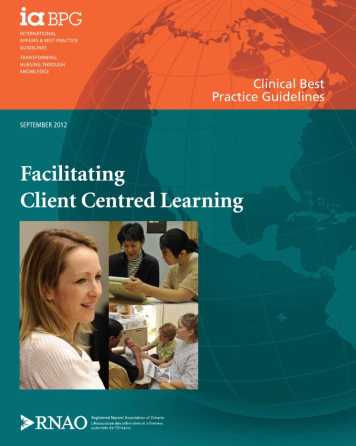
The purpose of this best practice guideline is to provide evidence-based recommendations related to nurses and other health care professionals providing effective client centred learning. This guideline will address the following areas: • How can nurses effectively facilitate client centred learning? • What are effective teaching delivery methods/ strategy for client centred learning? • How do nurses assess client learning? This guideline will be applicable to all domains of nursing including clinical, administration, and education. Registered Nurses’ Association of Ontario. (2012). Facilitating client centred learning. Toronto, ON: Author.
External link
The aim of this guideline is to provide evidence-based recommendations for registered nurses, registered practical nurses and other health-care providers to facilitate client centred learning that promotes and enables clients to take action for their health. Registered Nurses Association of Ontario ( 2012) Facilitating Client Centred Learning . Toronto. ON. 
External link
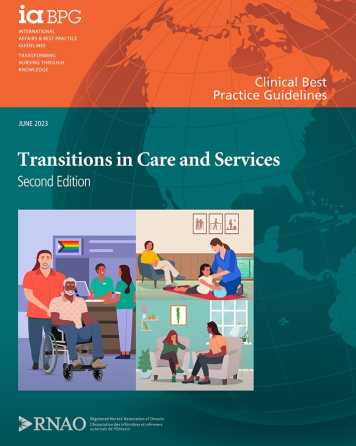
The purpose of the Transitions in Care and Services guideline is to provide evidence-based recommendations for nurses and members of the interprofessional team, organizations and the health system to support safe and effective transitions in care for pediatric (17 years and younger) and adult (18 years and older) persons and their support network. This BPG recognizes that persons and their support network who are encountering a transition in care are experts in their health and decision-making. Collaboration among the interprofessional team, the person receiving care and their support network is therefore essential to achieving improved health outcomes.  This BPG replaces the RNAO BPG Care Transitions published in 2014 (5). Registered Nurses’ Association of Ontario (RNAO). Transitions in care and services. 2nd ed. 2023, Toronto (ON). Author.
Document
The Ontario Primary Care Medication Reconciliation Guide provides quality improvement strategies for implementing, sustaining and measuring medication reconciliation in primary care settings in Ontario (167). A sample medication reconciliation form can be found on pages 43 and 44 of the guide. The Ontario Primary Care Medication Reconciliation Guide is also available in French. Registered Nurses' Association of Ontario. (2023). Appendix J of Transitions in Care and Services. (Second Ed.). Toronto, ON: Author.  pp. 126-127. Source: Reprinted with permission from: Institute for Safe Medication Practices (ISMP) Canada, Health Quality Ontario (HQO). Ontario primary care medication reconciliation guide [Internet]. Toronto (ON): ISMP Canada; 2015. Co-published with HQO.   
External link
This website offers resources to support the use of SBAR. SBAR offers a simple way to help standardize communication and allows parties to have common expectations related to what is to be communicated and how the communication is structured. Reference: Institute for Healthcare Improvement (IHI): © Institute for Healthcare Improvement.  
External link
The Fixing Long-Term Care Act, 2021 (FLTCA) was proclaimed into force to regulate Ontario's long-term care home sector. The Long-Term Care Homes Act, 2007 (LTCHA) was revoked, which means it is no longer in force. The new Act also includes a new regulation. Government of Ontario (2021) Fixing Long-Term Care Act, 2021. Toronto, (ON). © King’s Printer for Ontario, 2012-24 
External link
This PSHSA Fast Fact is intended to provide workplace parties with information that can help improve transition of care practices. Improving transitions in care results in improved employee and client safety. Reference: PSHSA - Public Services Health and Safety Association © 2025
External link
Public Services Health & Safety Association (PSHSA) web tutorial describes the transition of care process, challenges and opportunities to improve practice when supporting those going through a healthcare transition of care. PSHSA - Public Services Health and Safety Association © 2024.        
Document
 A tool to assist with comparing your organization’s current practice with evidence-based RNAO best practice recommendations. Registered Nurses Association of Ontario (2023). Opportunity Analysis-Transitions in Care and Service, 2nd edition. Toronto, ON.  
External link
This CNO document discusses the nurses’ role when working with unregulated care providers. Reference: College of Nurses of Ontario: Working With Unregulated Care Providers.  © College of Nurses of Ontario, 2025

Implementation resources

Document
5 Questions to Ask about Your Medications is a guide to help persons and their support network start conversations with health providers about their medications (168). Ensuring persons are active partners in their care, and ensuring they receive important information about their medications helps promote medication safety. It may be particularly helpful for persons to ask the following five questions about their medications when attending appointments with their primary care providers, communicating with their community pharmacist, and when preparing for a transition from hospital to home. The 5 Questions to Ask About Your Medications resource is available in 30 languages. Source: Reprinted with permission from: Institute for Safe Medication Practices (ISMP) Canada, The Canadian Patient Safety Institute (CPSI), Patients for Patient Safety Canada (PFPSC), et al. 5 questions to ask about your medications [Internet]. Toronto (ON): ISMP Canada; 2016. Co-published with CPSI and CFPSC. Registered Nurses' Association of Ontario. (2023). Appendix K of Transitions in Care and Services. (Second Ed.). Toronto, ON: Author.  pp. 128 . 
External link
Effective nursing practice is dependent on an effective therapeutic relationship between the nurse and the client. This guideline addresses the qualities and capacities of an effective therapeutic relationship, the state of knowledge, and the knowledge needed to be effective. To implement a therapeutic relationship successfully, an organization's characteristics and workplace values must be supportive and in place. An organization readiness assessment based on the best practice recommendations is provided. Supplement: 2006. Registered Nurses’ Association of Ontario. (2002). Establishing therapeutic relationships. Toronto, ON, Canada: Author.
External link
The purpose of this best practice guideline is to provide evidence-based recommendations related to nurses and other health care professionals providing effective client centred learning. This guideline will address the following areas: • How can nurses effectively facilitate client centred learning? • What are effective teaching delivery methods/ strategy for client centred learning? • How do nurses assess client learning? This guideline will be applicable to all domains of nursing including clinical, administration, and education. Registered Nurses’ Association of Ontario. (2012). Facilitating client centred learning. Toronto, ON: Author.
External link
The aim of this guideline is to provide evidence-based recommendations for registered nurses, registered practical nurses and other health-care providers to facilitate client centred learning that promotes and enables clients to take action for their health. Registered Nurses Association of Ontario ( 2012) Facilitating Client Centred Learning . Toronto. ON. 
External link
The purpose of the Transitions in Care and Services guideline is to provide evidence-based recommendations for nurses and members of the interprofessional team, organizations and the health system to support safe and effective transitions in care for pediatric (17 years and younger) and adult (18 years and older) persons and their support network. This BPG recognizes that persons and their support network who are encountering a transition in care are experts in their health and decision-making. Collaboration among the interprofessional team, the person receiving care and their support network is therefore essential to achieving improved health outcomes.  This BPG replaces the RNAO BPG Care Transitions published in 2014 (5). Registered Nurses’ Association of Ontario (RNAO). Transitions in care and services. 2nd ed. 2023, Toronto (ON). Author.
External link
The Fixing Long-Term Care Act, 2021 (FLTCA) was proclaimed into force to regulate Ontario's long-term care home sector. The Long-Term Care Homes Act, 2007 (LTCHA) was revoked, which means it is no longer in force. The new Act also includes a new regulation. Government of Ontario (2021) Fixing Long-Term Care Act, 2021. Toronto, (ON). © King’s Printer for Ontario, 2012-24 
External link
This PSHSA Fast Fact is intended to provide workplace parties with information that can help improve transition of care practices. Improving transitions in care results in improved employee and client safety. Reference: PSHSA - Public Services Health and Safety Association © 2025

Education resources

External link
This practice guideline provides an overview of the major features of the legislation, pertinent definitions, the steps nurses need to take to obtain consent and the Guidelines for Nurses Advocating for Clients Found Incapable of Making Certain Decisions. It replaces an earlier Guide to the Health Care Consent and Substitute Decisions Legislation for RNs and RPNs. It does not address consent under the Mental Health Act. © College of Nurses of Ontario, 2025
External link
This paper from the Institute for Safe Medication Practices in Canada (ISMP). A multi-incident analysis of delayed medication doses after transitions of care. Reference: Institute for Safe Medication Practices in Canada (2016) Delayed Treatment after Transitions of Care: A Multi-Incident Analysis
External link
College of Nurses of Ontario learning modules on the Documentation practice standard describes the expectations for nurses in all practice settings and for all forms of documentation. © 2025 College of Nurses of Ontario      
External link
Practice standards are documents that help nurses understand their responsibilities and legal obligations to enable them to make safe, effective and ethical decisions when practising. This practice standard aims to help nurses understand the regulatory and legislative requirements for documentation. © College of Nurses of Ontario, 2025.    
External link
This guidelines outline the importance of planning, choice and consent and adults with developmental disabilities receiving appropriate developmental services and supports in a long-term care home. The commitment to developing these guidelines and to following them also demonstrates the integrated and co-ordinated approach to care within and between the developmental services and long-term care home sectors. © King’s Printer for Ontario, 2012–to25
External link
Med Rec is a formal process to ensure accurate and comprehensive medication information is communicated consistently across transitions of care. This site provides information that can support medication reconciliation policies and procedures within organizations. Institute for Safe Medication Practices (ISMP). (2012).   
External link
The Medication practice standard describes nurses’ accountabilities when engaging in medication practices, such as administration, dispensing, medication storage, inventory management and disposal. Copyright © College of Nurses of Ontario, 2023.
External link
This website contains resources to assist when an individual with dementia is looking at transitioning to long-term care. The Alzheimer Society of Canada webpage has resources to support decision-making. ©2025 Alzheimer Society of Canada.
External link
My Transitional Care Plan© (MTCP) summarizes meaningful information that contributes to the facilitation of successful transitions across sectors for older adults presenting with, or at risk of, responsive behaviours/ personal expressions associated with dementia, complex mental health, substance use and/or other neurological conditions. brainXchange™.
External link
The Code of Conduct (Code) is a practice standard describing the accountabilities all nurses registered in Ontario have to clients, employers, colleagues and the public. It explains what people can expect from nurses. The Code also describes what nurses must do to maintain professionalism, competence and ethical behaviour to deliver safe client care. All nurses (Registered Nurses, Registered Practical Nurses, and Nurse Practitioners) are expected to uphold this practice standard, regardless of their role, title or responsibility. © College of Nurses of Ontario, 2025.
External link
This best practice guideline focuses on collaborative practice between RNs, RPNs and NPs and fostering healthy work environments for these nurses. Registered Nurses’ Association of Ontario. (2016). Intra-professional collaborative practice among nurses. Toronto, ON, Canada: Author. 
External link
This website offers resources to support the use of SBAR. SBAR offers a simple way to help standardize communication and allows parties to have common expectations related to what is to be communicated and how the communication is structured. Reference: Institute for Healthcare Improvement (IHI): © Institute for Healthcare Improvement.  
External link
Public Services Health & Safety Association (PSHSA) web tutorial describes the transition of care process, challenges and opportunities to improve practice when supporting those going through a healthcare transition of care. PSHSA - Public Services Health and Safety Association © 2024.        
External link
This CNO document discusses the nurses’ role when working with unregulated care providers. Reference: College of Nurses of Ontario: Working With Unregulated Care Providers.  © College of Nurses of Ontario, 2025

Evaluation resources

There are no evaluation resources available for this topic.

BPG appendices

Document
This interview guide from Alberta Health Services provides a list of questions health providers can ask when conducting a best possible medication history. Source: Reprinted with permission from: Alberta Health Services (AHS). Best possible medication history (BPMH) interview guide [Internet]. Edmonton (AB): AHS; 2014. This material is protected by Canadian copyright law. Except as otherwise provided for under Canadian copyright law, this material may not be copied, published, or distributed without the prior written permission of the copyright owner. This material was originally published by Alberta Health Services and has been reprinted with permission. Registered Nurses' Association of Ontario. (2023). Appendix I of Transitions in Care and Services. (Second Ed.). Toronto, ON: Author.  pp. 125.
External link
My Transitional Care Plan© summarizes information to facilitate successful transitions in care for older adults presenting with, or at risk of, responsive behaviours or complex mental health, substance use or neurological conditions (166). It provides a synopsis of essential information that should be communicated to members of the interprofessional team to prepare and facilitate a transition in care. The tool is written in first person to promote person-centred care, and health and social service providers should collaborate with persons and their support network when completing the form. My Transitional Care Plan© can be built within an electronic health record. The form is also available in French (166). Registered Nurses' Association of Ontario. (2023). Appendix H of Transitions in Care and Services. (Second Ed.). Toronto, ON: Author.  pp 123-124 Source: Reprinted with permission from: Behavioural Supports Ontario (BSO). 
Document
My Transitional Care Plan© summarizes information to facilitate successful transitions in care for older adults presenting with, or at risk of, responsive behaviours or complex mental health, substance use or neurological conditions (166). It provides a synopsis of essential information that should be communicated to members of the interprofessional team to prepare and facilitate a transition in care. The tool is written in first person to promote person-centred care, and health and social service providers should collaborate with persons and their support network when completing the form. My Transitional Care Plan© can be built within an electronic health record. The form is also available in French (166). Registered Nurses' Association of Ontario. (2023). Appendix H of Transitions in Care and Services. (Second Ed.). Toronto, ON: Author.  pp 123-124 Source: Reprinted with permission from: Behavioural Supports Ontario (BSO). 
Document
The Patient Oriented Discharge Summary (PODS) is an easy-to-use discharge summary designed for persons transitioning from hospital to home (164). Most traditional discharge summaries are dense documents with technical terms and are designed to communicate information to primary care providers, rather than persons receiving care. PODS was co-created with persons and their support network, including individuals with limited health literacy and language barriers, to help persons understand important information when leaving a hospital. The resource uses plain language, large fonts, space for persons to take notes and is available in 15 languages. Registered Nurses' Association of Ontario. (2023). Appendix G of Transitions in Care and Services. (Second Ed.). Toronto, ON: Author.  pp. 121-122.
Document
The Patient, Family and Caregiver Declaration of Values was drafted by the Minister’s Patient and Family Advisory Council in consultation with Ontarians to communicate patient, family and caregiver expectations of Ontario’s health-care system (163). The Declaration can serve as a compass for persons and organizations involved in health care and reflects a summary of important person, family and caregiver values. The Patient, Family and Caregiver Declaration of Values for Ontario is also available in French. Registered Nurses' Association of Ontario. (2023). Appendix F of Transitions in Care and Services. (Second Ed.). Toronto, ON: Author. pp. 120. Source: Reprinted with permission from: Government of Ontario. Patient family and caregiver declaration of values for Ontario [Internet]. Toronto (ON): Government of Ontario; 2021.  © Queen’s Printer for Ontario, 2021.  
Document
This resource lists topics and other Registered Nurses’ Association of Ontario (RNAO) guidelines, and resources from other organizations that align with the Transitions in Care and Services best practice guideline (BPG). Registered Nurses' Association of Ontario. (2023). Appendix B of Transitions in Care and Services. (Second Ed.). Toronto, ON: Author.  pp. 93-94.     
Document
The Ontario Primary Care Medication Reconciliation Guide provides quality improvement strategies for implementing, sustaining and measuring medication reconciliation in primary care settings in Ontario (167). A sample medication reconciliation form can be found on pages 43 and 44 of the guide. The Ontario Primary Care Medication Reconciliation Guide is also available in French. Registered Nurses' Association of Ontario. (2023). Appendix J of Transitions in Care and Services. (Second Ed.). Toronto, ON: Author.  pp. 126-127. Source: Reprinted with permission from: Institute for Safe Medication Practices (ISMP) Canada, Health Quality Ontario (HQO). Ontario primary care medication reconciliation guide [Internet]. Toronto (ON): ISMP Canada; 2015. Co-published with HQO.